
When man’s best friend tells the time
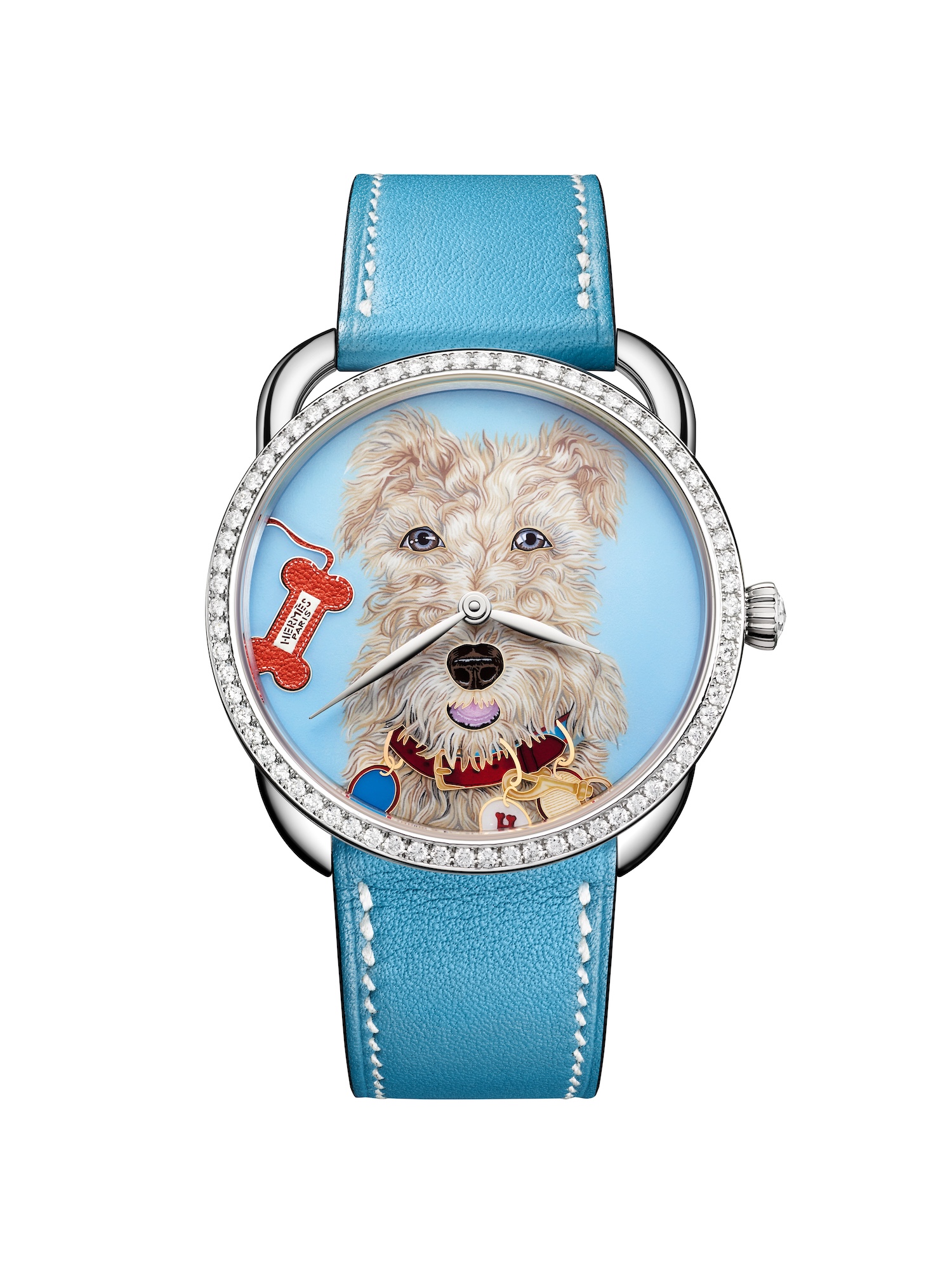
With its Métiers d’art Arceau Jour de casting watches, Hermès pays tribute to man’s best friend. Three dogs, three dials, for a series of 24 pieces. Hermès called on several artisans practising different crafts to create this amusing bestiary: wood marquetry, engraving, miniature painting, cloisonné enamel and miniature enamel. In order to understand the complexity of these pieces, a visit to the Miniare enamel workshops was essential. Isabelle Cerboneschi
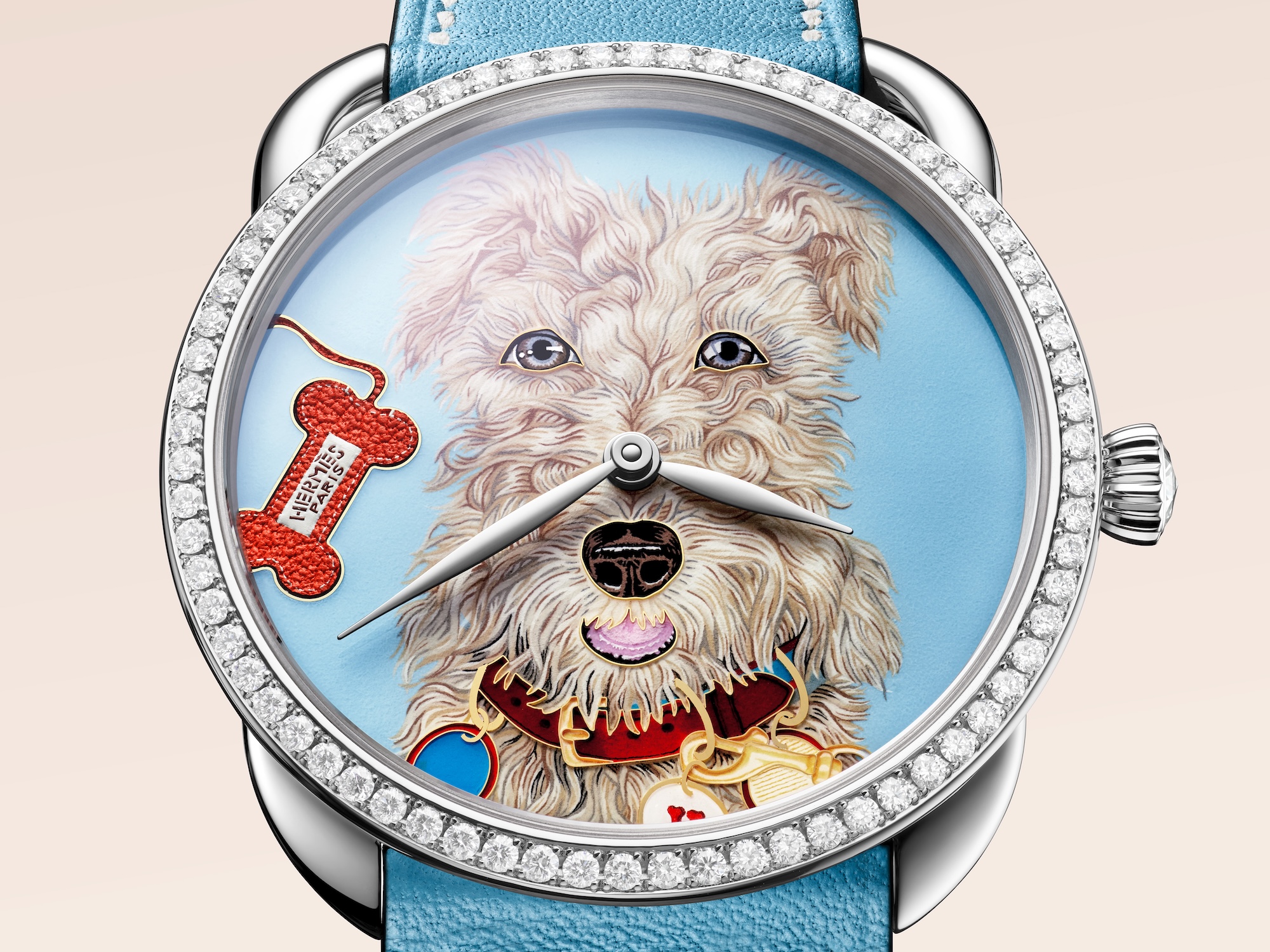
Hermes Arceau Jour de casting, Taco, copyright Anita Schlaefli
These are undoubtedly the most irresistible watches I have come across this year. The Arceau Jour de casting collection by Hermès, a limited series of 24 pieces, unveils three adorable puppies dressed in their finest attire, ready to take part in a dog show. The dials are inspired by the eponymous silk scarf designed by artist Liz Stirling. How can anyone resist such cuteness?
Let’s start with the introductions. First up is Orson, a black and white dog made from painted wood marquetry. A total of eight different types of wood were used to create this precious puzzle. Next is Amy, definitely the most fashionable. With their psychedelic glasses, they took shape in an engraver’s workshop, then a painter gave them their colours. Finally, there is Taco, looking straight into our eyes with their brown-blue gaze as if to say, ‘vote for me’.
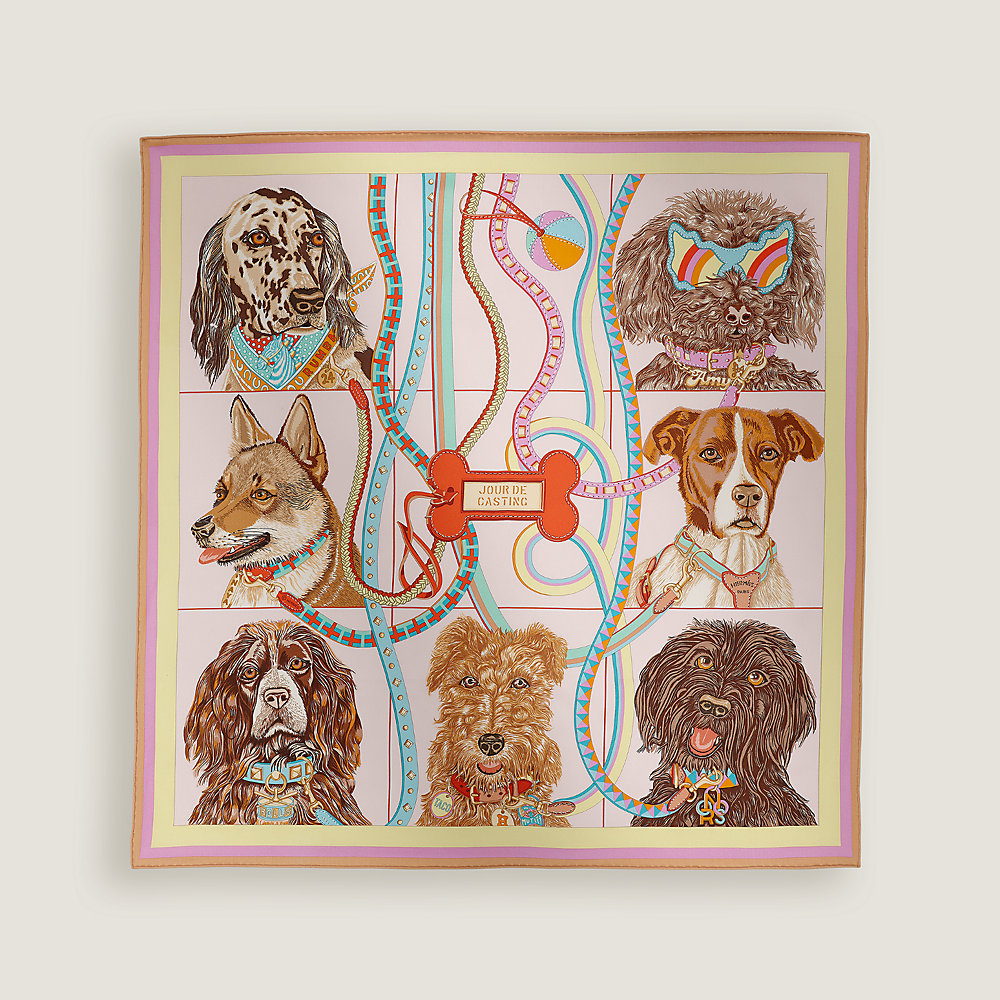
The dials in the Arceau Jour de casting series are inspired by the eponymous silk scarf designed by artist Liz Stirling ©Hermès
The call was heard. We headed behind the scenes to discover how this tiny cloisonné enamel miniature animal was created in the Miniare workshop in Nyon, co-founded by enameller Debora Martinez and her partner Francisco Morales.
With a Master’s degree in visual arts from Spain, she was the last artisan to be trained in the workshop of Dominique Baron, the great art enameller and miniaturist painter, before perfecting her skills at Blandenier for three years.
The workshop counts some of the biggest names in watchmaking among its clients. ‘Not having had a master to pass on all the skills of enamelling directly to me, I was able to develop this art in my own way, through trial and error,’ she explains. ‘Even though the rules of this craft were established hundreds of years ago, our generation, now approaching thirty, has a more experimental, more daring vision of it. We can afford to break a few rules.’
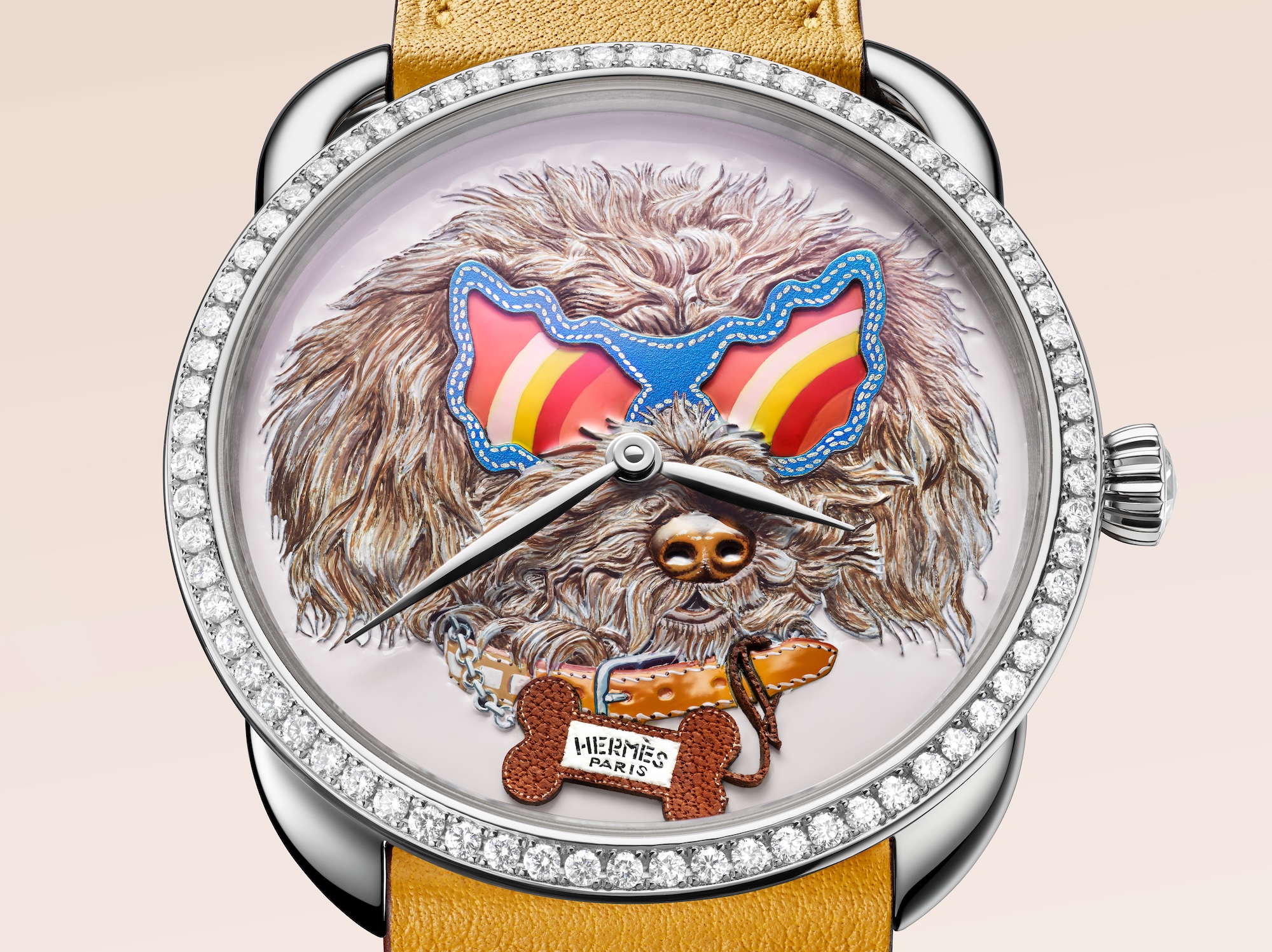
Arceau Jour de casting, Amy, copyright Anita Schlaefli
Hermès quickly offered her projects, one of which was a dial featuring a portrait of the dog Taco, with his gentle gaze rimmed with gold, his fur less well groomed than himself, his shiny nose, his red collar, and, of course, his Hermès leather bone.
Once a motif has been chosen by Philippe Delhotal, creative director at Hermès Horloger, to adorn a Métier d’Art watch, it is important to give it as much relief as possible, while respecting a maximum height that allows the hands to turn. ‘The design will define the techniques,’ explains Philippe Delhotal. ‘The aim is to give the motif as much relief, depth and life as can be seen in the silk design. That’s why we decided to use several techniques for this model: grand feu enamel, miniature painting in enamel underglaze, cloisonné and champlevé.’ Not to mention a small added piece that was carefully crafted in the Hermès leather workshops: Taco’s bone.
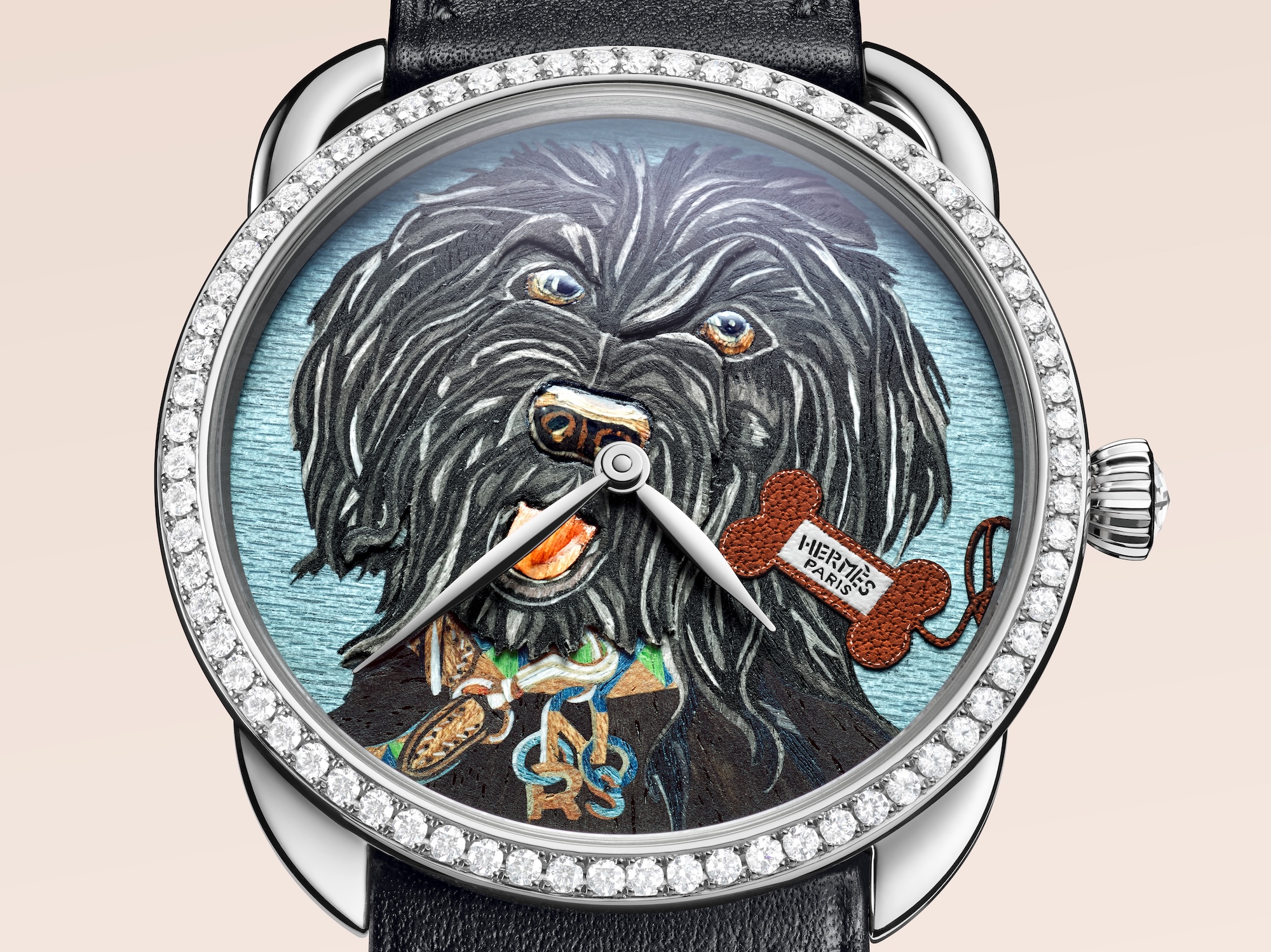
Arceau Jour de casting, Orson, copyright Anita Schlaefli
To illustrate the complexity of the piece, Debora demonstrated a few steps live on the day of our visit. She placed a neutral dial under the binocular microscope to apply the blue-grey enamel that forms the background. We can see the shape of the small champlevé bone. The material she uses is enamel in grains, which has been crushed and ground into a powder that she has mixed with distilled water. She then applies the material to the dial with a brush, trying to spread it as evenly as possible.
When you look through the binoculars, you can see the grains. “This first part is complex because you have to achieve a perfectly flat surface. You have to manage the water, the movement, the amount of pigment. It’s a bit mysterious: through the binoculars, you just see grains moving around, and it’s the movement of my brush that tries to stretch them out and flatten them. If I put too much on, it could create bumps,” explains the enameller. The dial is fired in a oven at between 700 and 800 degrees, and all the grains melt together. The process has to be repeated two or three times before polishing this base, on top of which the mischievously little dog is to be painted.
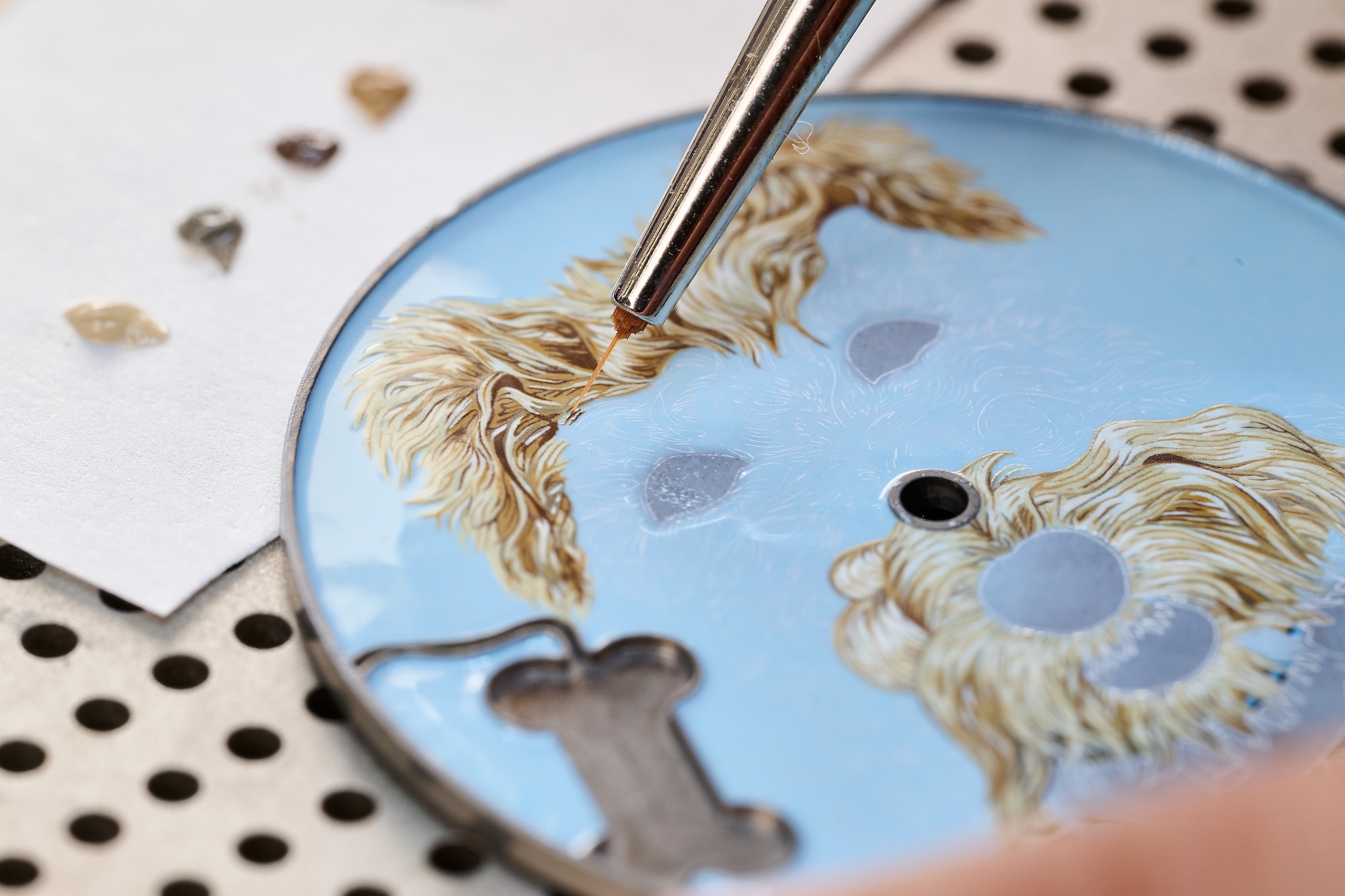
To paint the tip of a dog’s hair, the artist uses a brush with only six bristles Photo: David Marchon
To complete the second stage of the dial, Taco’s portrait, Debora Martinez used the miniature enamel technique, which involves mixing very fine enamel powder with oil. ‘As we had to stay true to the colours of the original drawing, we had to do a lot of research beforehand, mixing different shades to achieve the desired result,’ she explains. The artist then reveals a few small notebooks in which touches of colour are matched with formulas. These are the secret recipes for certain shades.
You have to look at the dial through a magnifying glass to fully appreciate how challenging this piece is: every hair on the dog, however fine, is represented. ‘Only the technique of miniature enamel painting allows us to achieve such a fine finish,’ explains the enameller. The brushes she uses are much finer than those with which she created the blue-grey background of the dial. Unlike water-based enamel, the grains do not spread: they are compact and remain in place. ‘This is the characteristic of miniature painting: it is like oil painting, but with a structure made up of micro-grains of enamel,’ she explains. Debora Martinez uses sandalwood, lavender, lily or clove oil as a binder.
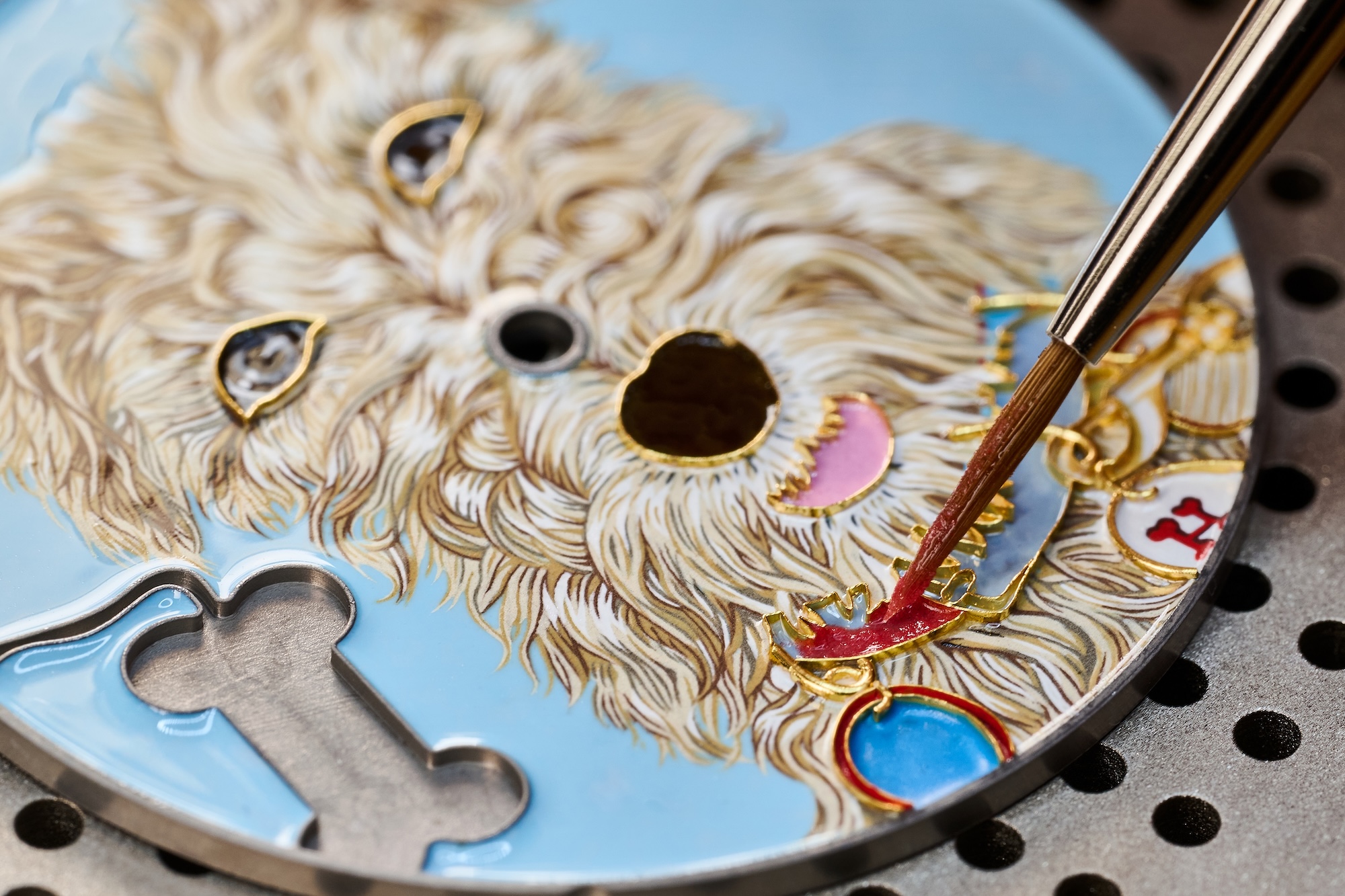
The red of the collar, which is a very complex colour, is applied at the end Photo: David Marchon
We come to the crucial moment when the artist has to paint the tip of a dog’s hair. To do this, she uses a brush with only six bristles. “The interesting thing about miniature painting is that it doesn’t dry. You can push the grains a little and create very slightly raised patterns, a bit like micro-sculpture. It’s a different way of painting,‘ she continues. The red of the collar, which is a very complex colour, is applied at the end. ’It’s a soft shade that liquefies and tends to rise to the edges with each firing.‘
The small gold wires of the cloisonné that define Taco’s eyes, nose, tongue, bone and collar are glued to the dial with gum arabic glue. Some are 0.05 microns thick. The junction with the enamel on the dial is made during vitrification in the kiln. Given that gold melts at 1000 degrees, the heat must not exceed 700-800 degrees.
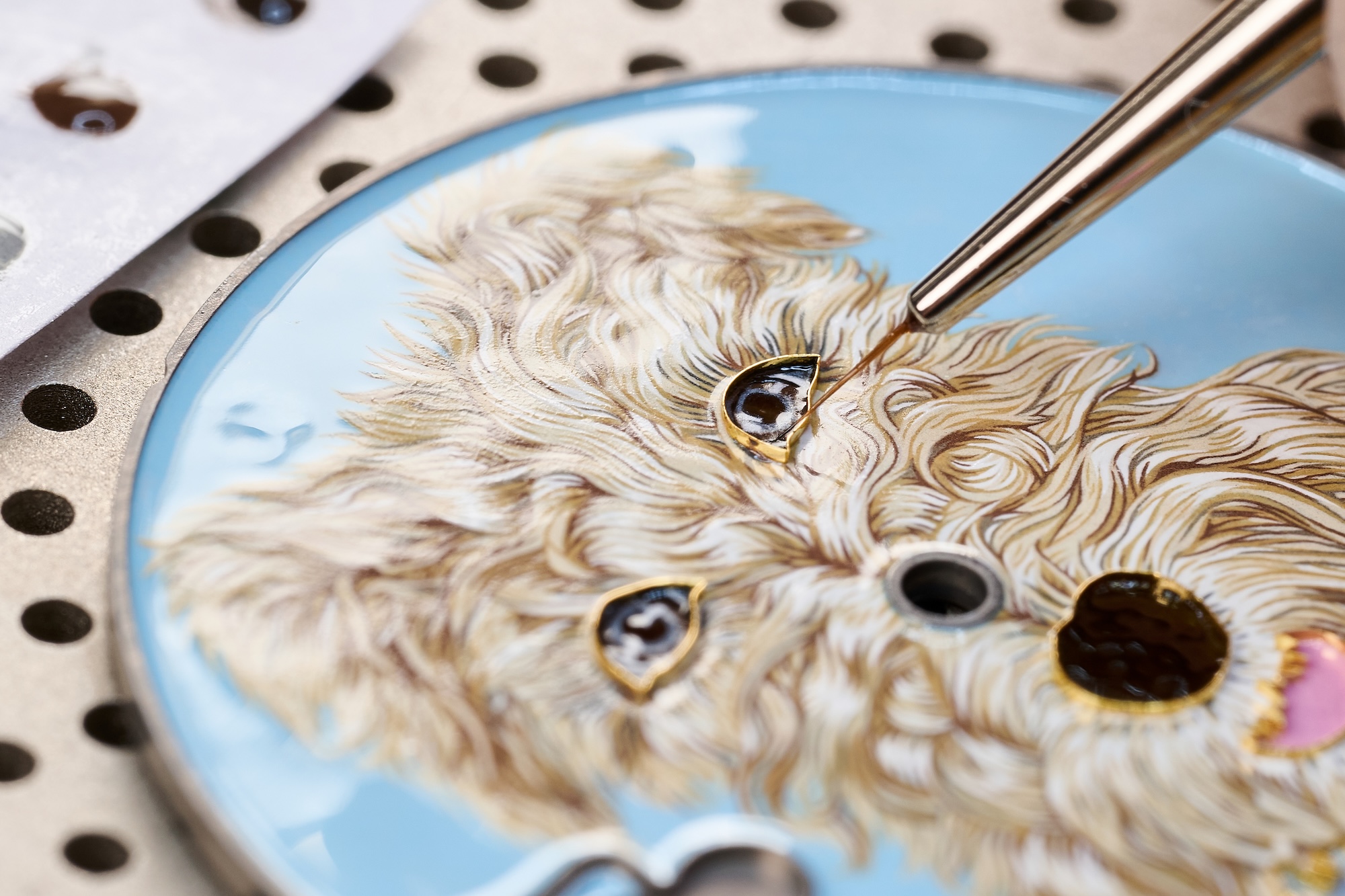
The small gold cloisonné threads that define Taco’s eyes, nose, tongue, bone and collar are glued to the dial with gum arabic glue. Photo: David Marchon
Once the cloisonné is in place and the miniature is complete, the flux is applied, which is a translucent enamel applied with water to create a kind of protective glass over the image. The piece is fired again at between 700 and 800 degrees. ‘One of the difficulties of this stage is that the layers underneath the fondant can shift when heated,’ notes Debora Martinez. And when you consider that the dial requires between 20 and 30 firings, you can imagine the cold sweats experienced by the whole team. ‘When we apply the glaze, it’s a big step: it means that the piece is finished and there’s no going back. There comes a point when the piece no longer belongs to us,’ she emphasises.
There is still one small but important detail left: attaching the little orange leather bone signed by Hermès with its mini white stitches in the space reserved for it. Made in the Hermès workshops, it is glued underneath and on the edge using the same material used for leather marquetry, a technique that the House has been mastering since 2017.
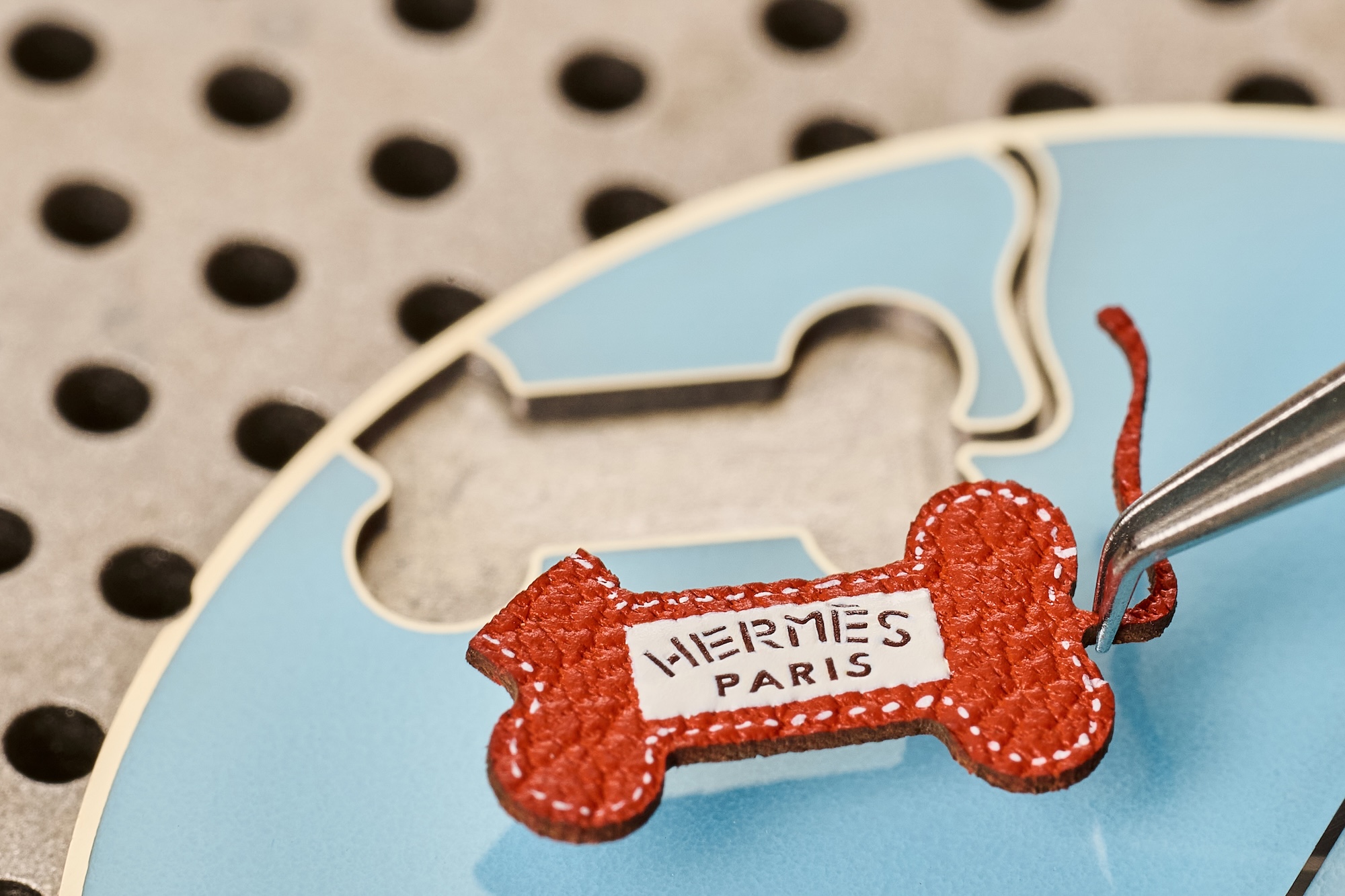
The small orange leather bone signed Hermès with its mini white stitches is placed in its designated space. Photo: David Marchon
“Everything you’ve seen is the result of hours of reflection before moving on to the actual production. We had to carry out numerous tests to achieve the pink of the tongue, the golden effects of the dog’s collar, its grey-brown eyes and the red collar. The proportions are noted in our notebooks, but ultimately the eye is the best judge. When we reach the end, it’s a celebration,” explains Debora Martinez.
Once finished, the dial is sent to Biel, to the workshop dedicated to artistic crafts, where two watchmakers work on assembling the case. The piece passes through other hands, and until the very end, there is always an element of risk. ‘From the first brushstroke, the entire process is an uninterrupted series of risks,’ notes the artist.
“The Arceau Jour de casting watch expresses all the playfulness of the animal world through exceptional techniques: miniature painting, wood marquetry and enamel. The three mischievous, well-groomed dogs posing in the centre of the dial are inspired by the pets of some Hermès employees. They even bear their names: Orson, Amy and Taco,” reveals Philippe Delhotal. This timepiece is much more than an exercise in style around the arts and crafts: in a tiny amount of space, it brings together the spirit, expertise and sheer enchantment of Hermès.