
Jewellery goes white with Pantone’s Cloud Dancer
Last December, Pantone® announced that its ‘colour of the year 2026’ would be called Cloud Dancer. It is a very soft white that borders on chromatic abstention. This cloudy shade, which calms the mind and evokes a snowy landscape or the lustre of a natural pearl, has all the qualities to inspire jewellers. Catherine De Vincenti
White does not exist. Or rather, it exists so much that it encompasses all colours. It results from the reflection of visible wavelengths: it absorbs almost nothing, reflects all light and, by a curious paradox, absorbs our certainties. How can this nuance be translated? In jewellery, white can be soft like a pearl, rich like Mutton Fat jade (nephrite), or opaque and mysterious like a white opal. It can be reassuring, flattering or sorely lacking in punch.
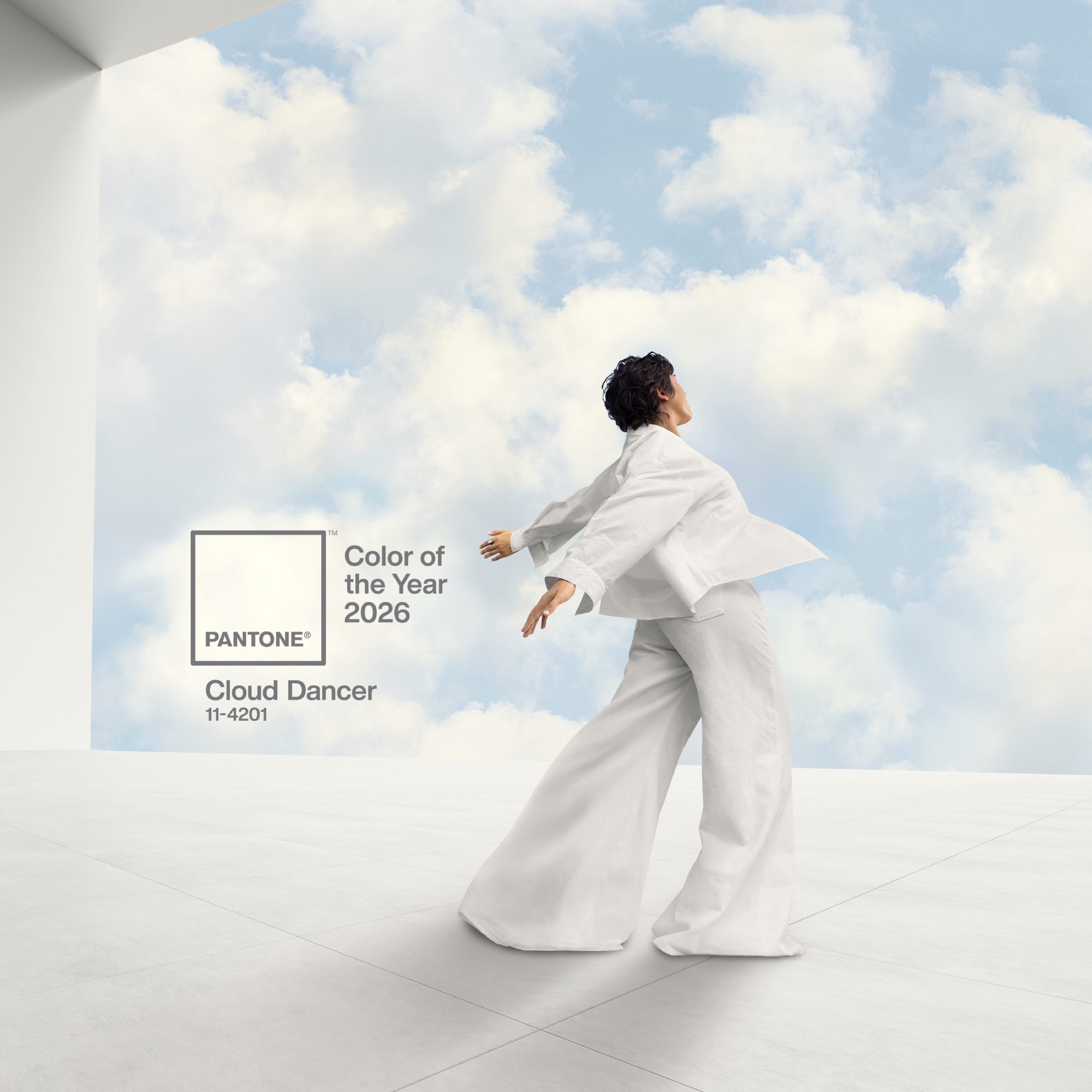
Last December, Pantone® announced that its ‘colour of the year 2026’ would be called Cloud Dancer ©Pantone
The Pantone Matching System (PMS)
Pantone and its PMS (matching system) is not an oracle that fell from the sky, but a formidable tool for synchronising taste and colours. A visual metronome that allows fashion, design, beauty and, with a slight time lag, jewellery to speak with one voice. We may roll our eyes at Cloud Dancer, but the fact remains: Pantone dictates, and the market follows.
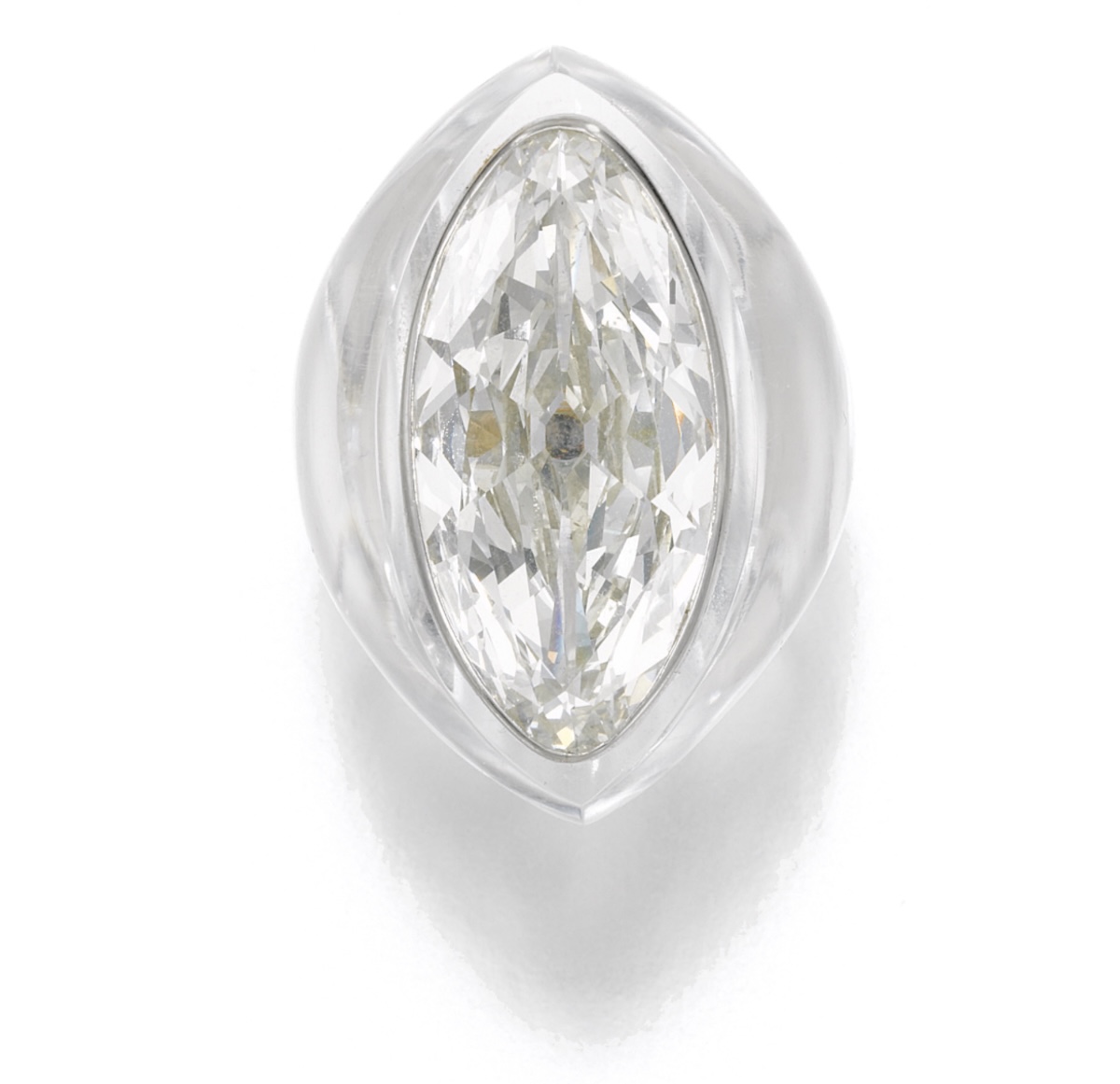
Suzanne Belperron, rock crystal ring set with a navette-cut diamond, approx. 3.75 carats. An exceptional play of transparencies within a single piece of jewellery, dated between 1932 and 1940, illustrating her innovative ‘stone-set’ technique, using a minimum of metal so that the precious stones appear to float. Photo ©Belperron
What shall we do with Cloud Dancer?
The world of gemstones has an advantage over other disciplines: diamonds have long been king. Like Cloud Dancer, it plays on the absence of colour, but adds an effect of transparency, brilliance and fire that Pantone’s new colour cannot match. In every piece of jewellery, diamonds assert their advantage and superiority. But white stones and organic materials, often opaque or translucent, are much more numerous than you might think. Each has its own subtle, discreet charm, capable of standing up to Cloud Dancer in the hushed world of jewellery.
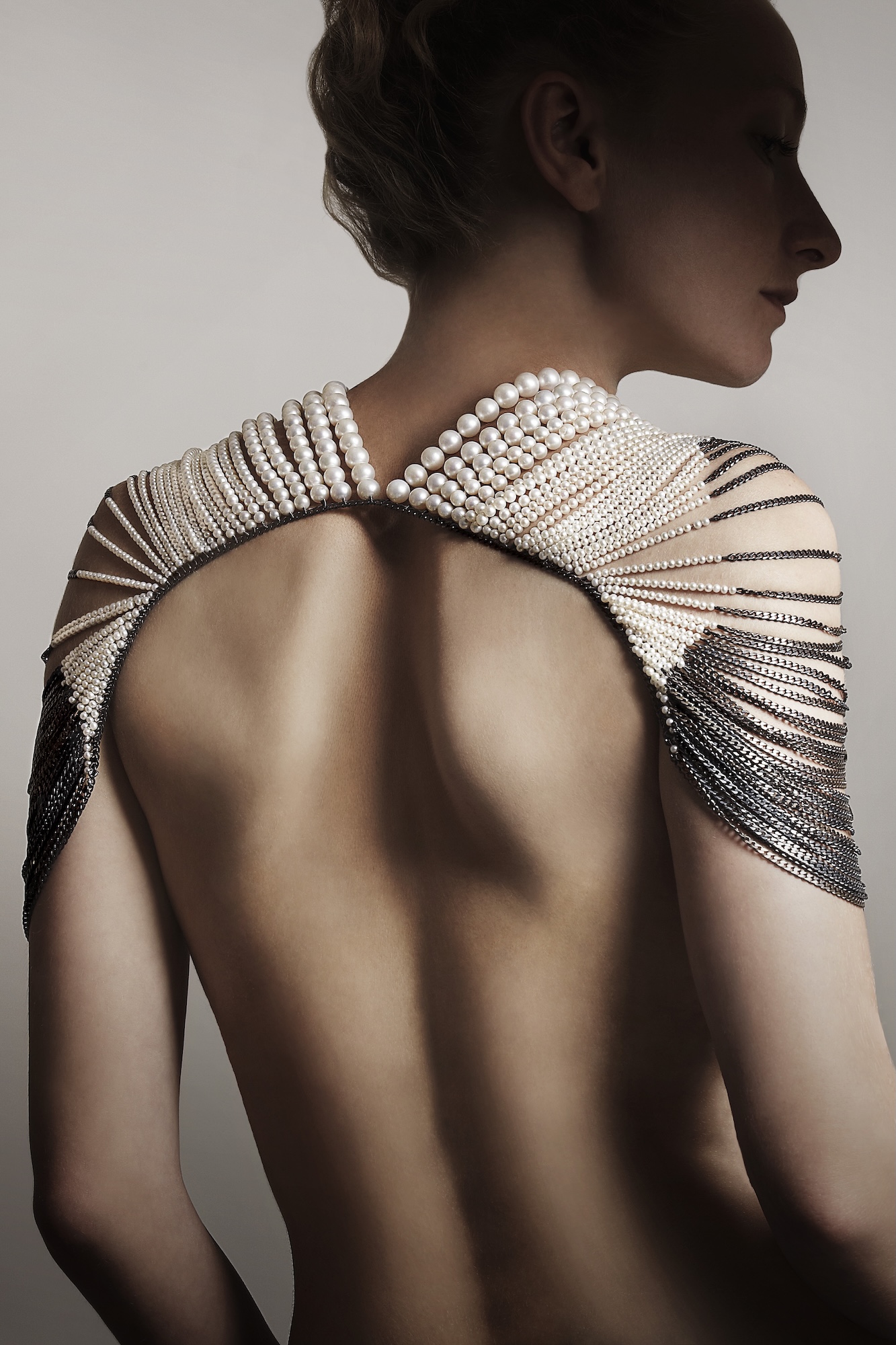
Shoulder jewellery ©Melanie Georgacopoulos
Pearls, that precious organic material
‘The pearl!’ exclaimed Laurence Janin-Schlemmer, journalist and creator of the podcast ‘Laur’loge à l’heure du luxe’ , as we discussed the refinement of white. And what creative richness: round pearls, baroque pearls, small or large, in various shades, with a brilliant or subtly matte lustre. Long neglected, it has regained its prestige in recent years, thanks to designers such as Mélanie Georgacopoulos. As for ivory, although it is now protected by CITES (the Convention on International Trade in Endangered Species of Wild Fauna and Flora), also known as the Washington Convention, it was widely used until the 1980s in jewellery that was breaking away from traditional jewellery design. René Lalique, who worked at the turn of the 19th and 20th centuries, used it extensively in his enamelled mini-sculptures, combining virtuosity and delicacy.
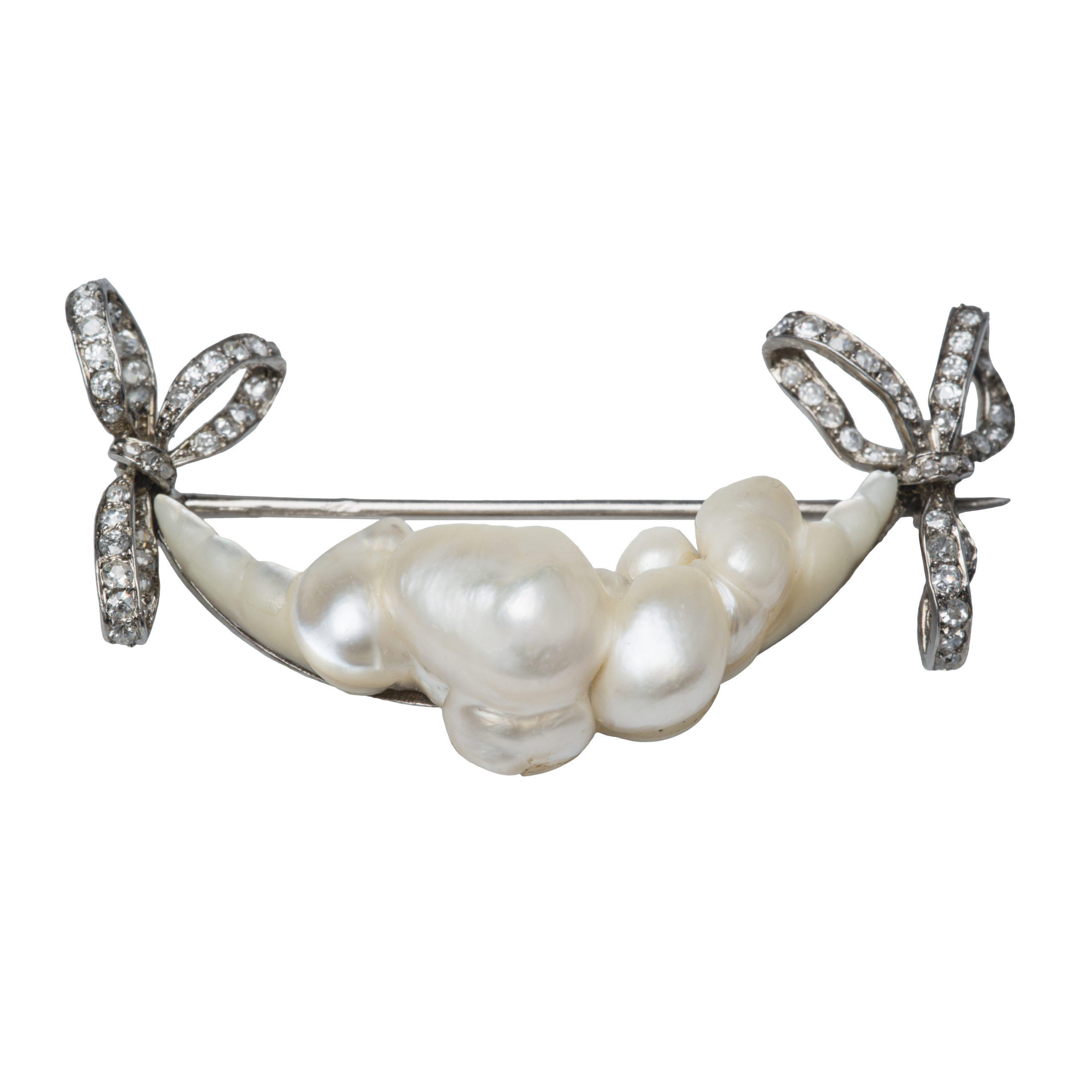
Lalique, Bow and Pearl Brooch. This early 20th-century brooch features small diamond-encrusted bows and an extraordinary baroque pearl. Photo ©Arts in the City
Moonstone and Art Nouveau
During the Art Nouveau period (1890-1910), some designers favoured stones that were softer than diamonds, a little languid, indolent, almost dull. The colour then vibrated thanks to the enamel. What gemstone better than moonstone, among others, perfectly illustrates this description? Translucent to opaque, with or without bluish adularescence or rainbow effect, this stone shows little interest in its whitish, average to mediocre qualities. Sometimes animated by a slight ‘cat’s eye’ effect, it is perfect for evoking a winter landscape.
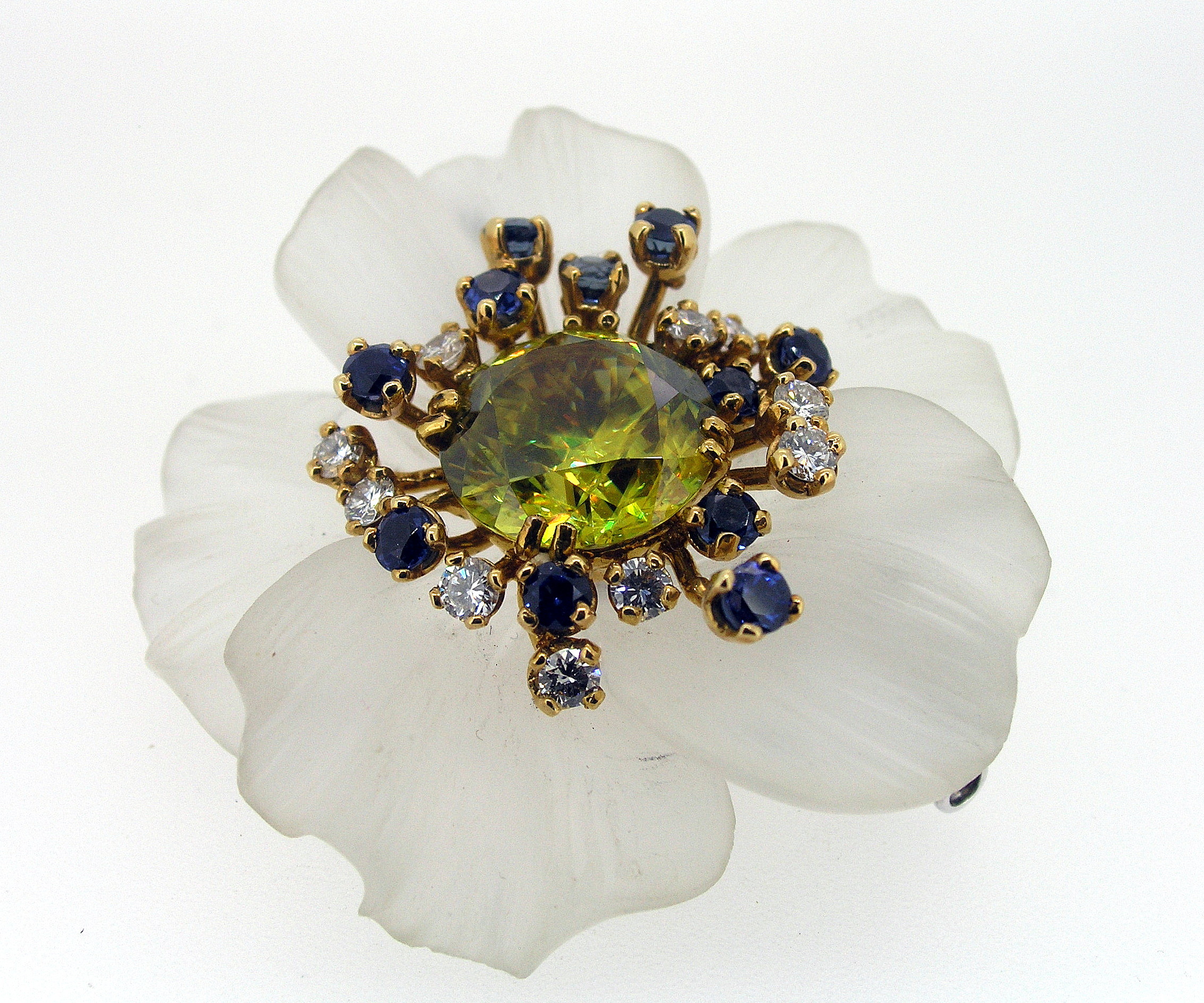
Rock crystal, sapphire, brilliant-cut diamond and sphene brooch, Chaumet setting. The setting, signed Chaumet, highlights the satiny petals of the rock crystal brooch and the central sphene (a calcium and titanium silicate whose colour palette ranges from yellow-green to green-brown) whose fire surpasses that of a diamond or demantoid garnet. Photo ©CdV Consulting. Private collection.
Mutton Fat Jade
The name ‘jade’ actually refers to two distinct stones: jadeite and nephrite, which are often confused but are profoundly different in structure. Mutton Fat Jade is, in fact, a creamy white, slightly translucent nephrite with a satin polish and a ‘fatty’ appearance that was highly sought after in imperial China. While jadeite, with its fine, compact crystalline structure, displays bold, saturated colours and very pure whites, sometimes with a dazzling brilliance, the beauty of ‘Mutton Fat’ jade lies in the depth, softness and almost sensual feel of the material. It is a jade for contemplation, often used in carved and openwork plaques, revered in China for thousands of years
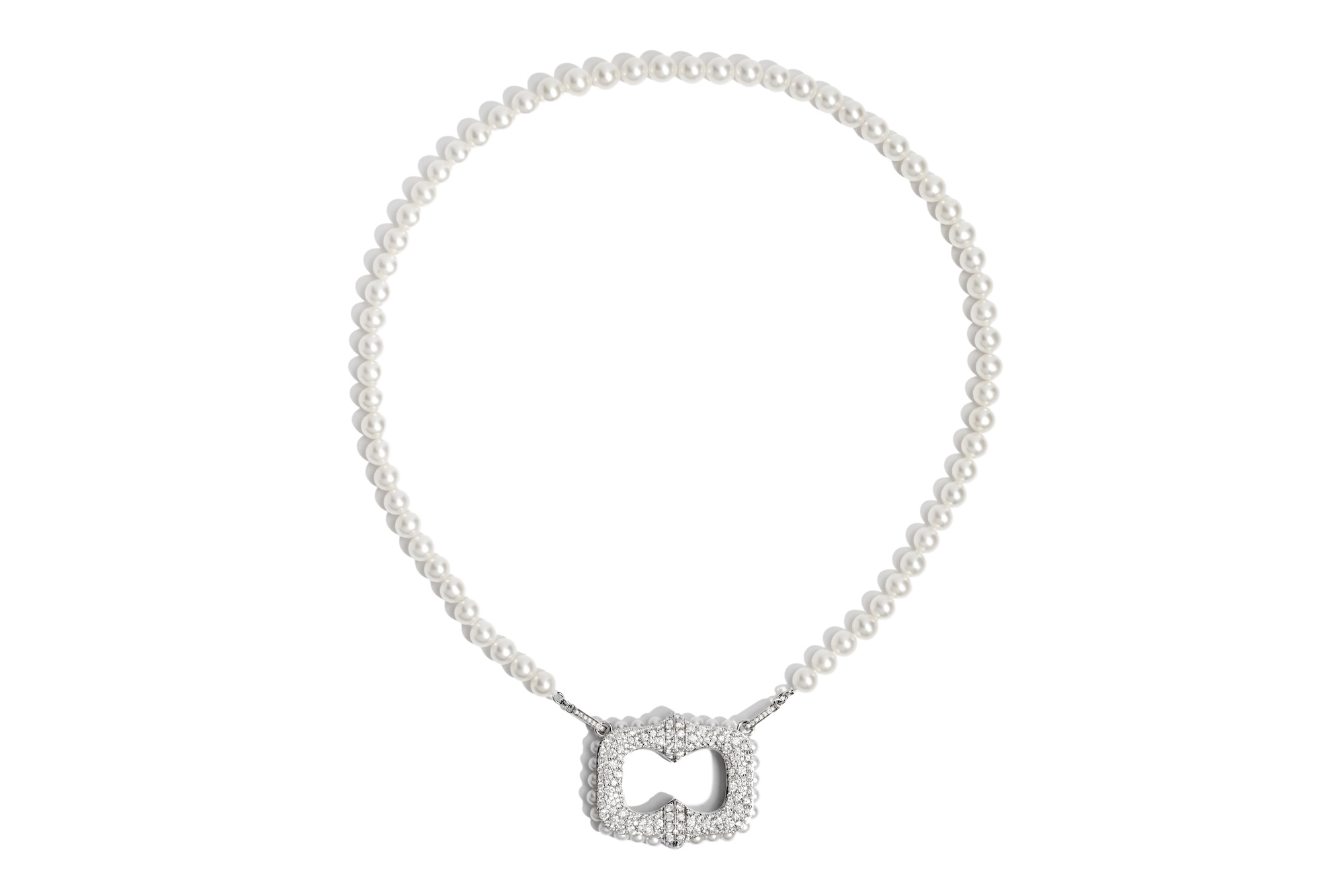
Pearl, white gold and diamond necklace ©Statement
Cloud Dancer calls not for ostentation but for nuance. It favours materials that diffuse light rather than those that dazzle. In this respect, it is perfectly compatible with jewellery that seeks to reassure, to last, to pass through the seasons without making too much noise. Like snow settling on the surrounding landscape, bringing with it silence and peace.