
Hublot X Yohji Yamamoto, l’œuvre au noir
The watchmaking manufacture has just launched a new model – Classic Fusion Yohji Yamamoto All Black Camo – which is a collaboration with one of the last giants of fashion, a master, Yohji Yamamoto. Julien Tornare, the brand’s CEO, recounts the genesis of this rare object. Isabelle Cerboneschi
It is black, black like a manifesto, with shades on the dial that evoke a camouflage pattern. It is both pure and complex, like the clothes of Yohji Yamamoto, the last great master of fashion.
When you look at this watch, the alliance between Hublot and Yohji Yamamoto seems obvious. Hublot was born in 1980 from a disruptive idea, combining rubber with gold, and Yohji Yamamoto presented his first collection in Paris in 1981, which was also disruptive with the advent of black and deconstructed shapes without hems.
‘There is, in fact, something deeply natural about this alliance,’ notes Julien Tornare, CEO of Hublot. Hublot and Yohji Yamamoto were born almost mirror images of each other, one year apart, with the same desire to question established conventions. Both Houses are considered “intellectual rebels” in their respective fields, watchmaking and fashion, challenging traditional principles and constantly pushing boundaries. At Hublot, this has been the Art of Fusion since 1980, daring to combine gold and rubber, heritage and innovation. At Yohji Yamamoto, it has been deconstruction, black as a manifesto, a radical response to ornamentation and excess. This partnership goes far beyond a stylistic exercise. It expresses a shared vision of luxury that seeks to seduce not through glamour, but through accuracy, durability and essence”.
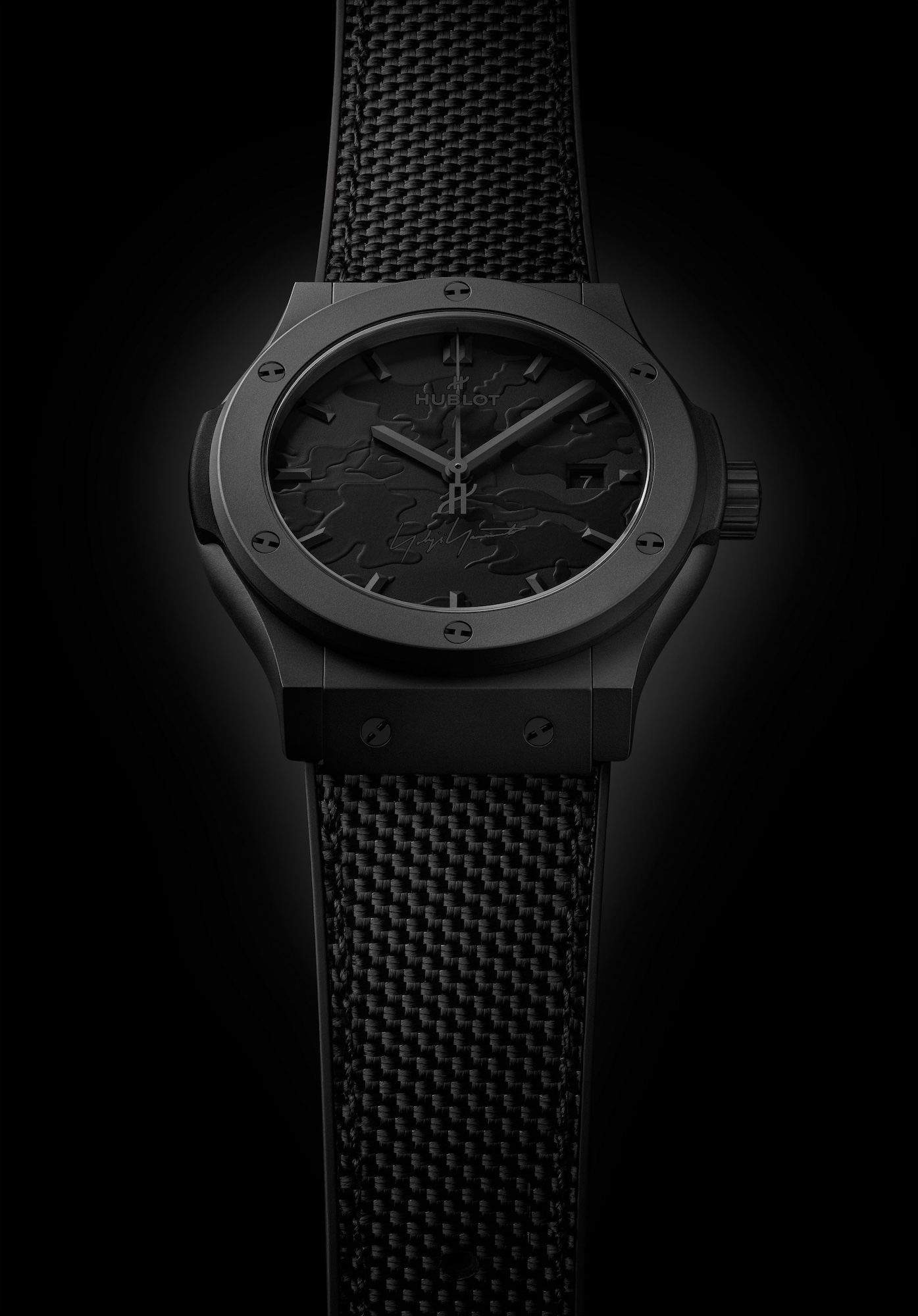
Hublot, Classic Fusion Yohji Yamamoto All Black Camo
Let’s go back to 1980. The watchmaking industry was still suffering from the emergence of quartz, which had almost wiped out mechanical watches.
Carlo Crocco, an Italian entrepreneur, had the surprising idea of combining sport and chic by creating the MDM company and launching the Hublot watch, which was inspired by the design of yacht portholes with 12 screws and unconventionally combined gold and natural rubber.
Carlo Crocco presented his models at what was then known as the Basel Fair. To say that the reception was lukewarm would be an understatement, but when His Majesty King Juan Carlos I bought a model, the watch literally gained recognition and created a buzz.
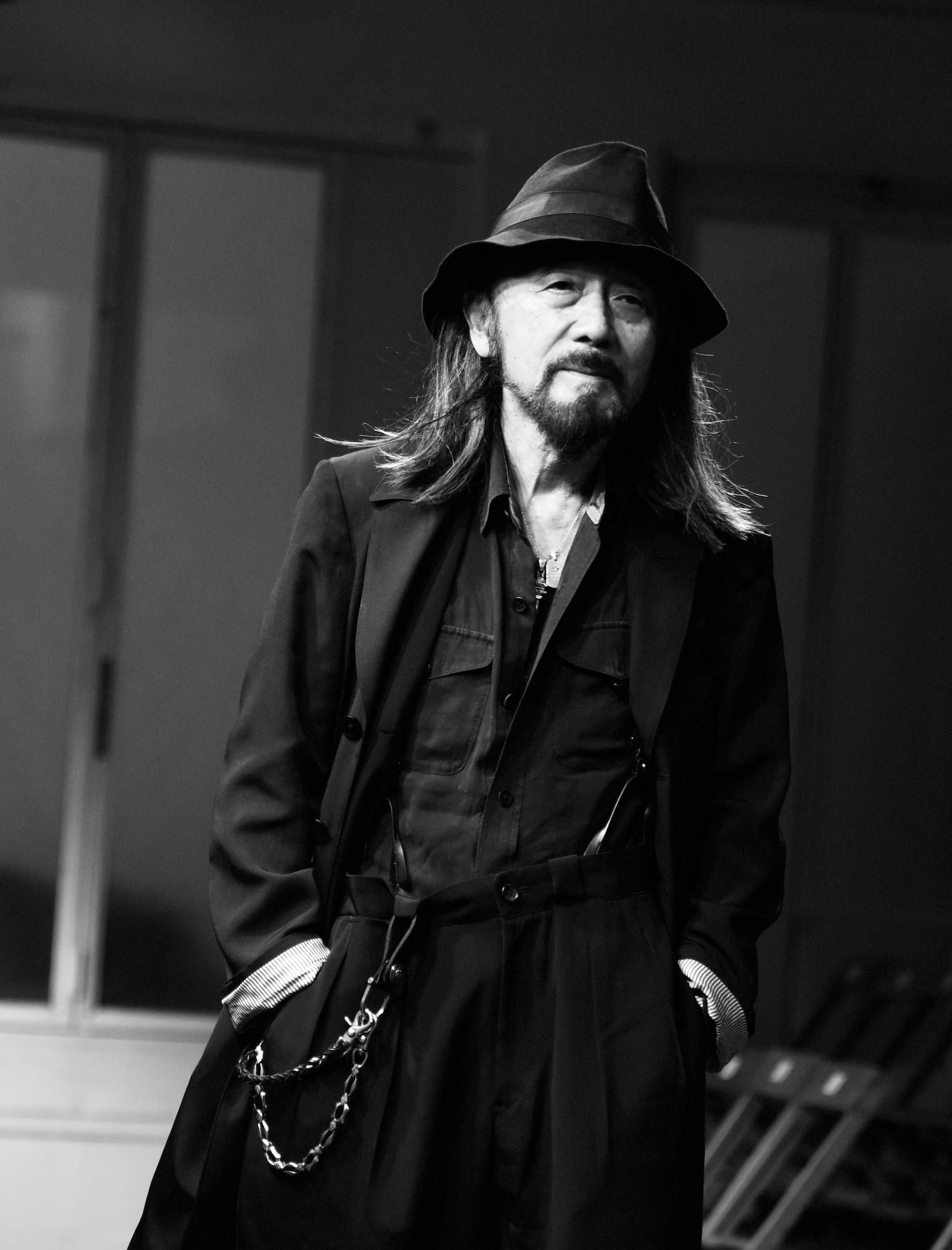
Yohji Yamamoto, SS 19, ©Elise Toïdé
A year later, in 1981, the young Japanese designer Yohji Yamamoto presented his first collection in Paris. The reception was more than chilly: the majority of journalists hated what they saw and wrote about it in an unflattering manner.
At that time, fashion emphasised women’s curves, with strongly defined waists and very broad shoulders designed by Mugler or Montana, intended to allow women to assert their power, or to try to take it from those who were not prepared to give it to them. On the one hand, there were bodies moulded into clothes that hugged every curve; on the other, there was a movement, more than a fashion, that started on the streets and imposed its rips, excesses and disillusionment: the punk movement.
And in the midst of all this was Yohji Yamamoto, who arrived from his native Japan with his desire for deconstruction and made his debut in Paris at the same time as Rei Kawakubo, the artistic director of Comme des Garçons, who would later become his partner. Their fashion was described as ‘Hiroshima Chic’ by their detractors who, in a swing of the pendulum that is so common in the fashion world, quickly became their most fervent admirers. This man, who describes himself as a ‘clothes maker’, has succeeded in imposing a fashion that appeals not only to the body but also to the mind, with black as its signature colour.

Julien Tornare, CEO Hublot
So when Julien Tornare is asked how this model is a ‘fusion’, if one dares say so, between the two styles of Hublot and Yohji Yamamoto, he replies that “the fusion is total, because it is conceived from the material itself. At Hublot, black is sculpted: matte ceramic, volumes, textures, plays of light and shadow. At Yohji Yamamoto, black is woven: it lives, it breathes, it accompanies the movement of the body. On the Classic Fusion Yohji Yamamoto All Black Camo, these two approaches come together. The camouflage is not decorative, as it is embossed, black on black, almost invisible at first glance, but alive in changing light. The case absorbs light, the dial transforms it, and the strap combines fabric and rubber like a dialogue between couture and engineering. That is exactly what the Art of Fusion is all about,” he continues.

Hublot Big Bang Unico Camo Yohji Yamamoto
The Classic Fusion takes up the camouflage motif of the Big Bang Camo by Yohji Yamamoto and the monochrome black of the GMT All Black Yohji Yamamoto. This choice raises questions: is it a sign of a strengthening of this line? ‘The choice of the Classic Fusion is very intentional,’ admits Julien Tornare. “It is Hublot’s most refined collection, the one that leaves the most room for expression. After exploring the world of Yohji Yamamoto on the Big Bang and the GMT version, it seemed natural to us to move towards a quieter, more introspective and more contemporary piece. This limited edition also demonstrates that the Classic Fusion is not a secondary line, but a powerful medium for expression, capable of hosting highly conceptual collaborations. It embodies a more mature, sustainable vision of luxury, perfectly in line with the DNA of our two houses.”

Hublot Big Bang GMT All Black Yohji Yamamoto
This model does not have a defined gender. ‘It is aimed at a clientele that does not think in terms of traditional codes or gender,’ points out Julien Tornare. ‘Women and men who are sensitive to design, fashion and architecture, who understand that black can be a signature, not a neutrality. It is a piece for those who seek a form of discreet, almost intellectual sophistication. Collectors, but also creative types, who see luxury as a personal expression, not an outward sign. As Yohji Yamamoto himself says: “Black is both humble and arrogant.” I agree with him, and that’s exactly what this watch is!”
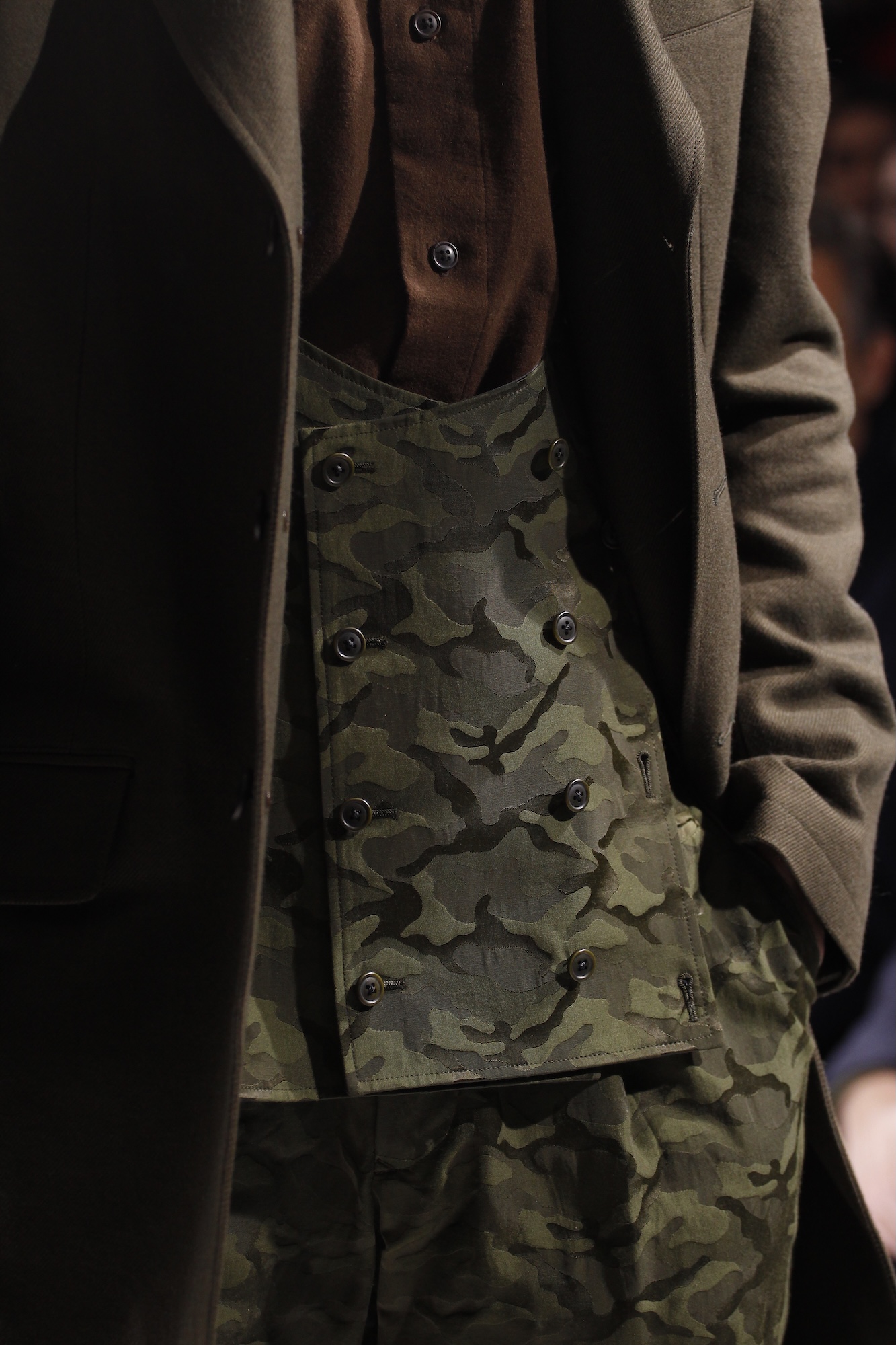
Yohji Yamamoto FW 17-18 collection ©Monica Feudi