
Chopard’s Insofu Collection born from a 6,225-carat emerald
Back in Paris in 2022, Caroline Scheufele, co-president and artistic director of Chopard, unveiled for the first time an enormous rough emerald discovered in the Kagem mine in Zambia. Its weight? 6,225 carats! It took three years for a capsule collection of 15 pieces to emerge from this extremely rare stone. Isabelle Cerboneschi
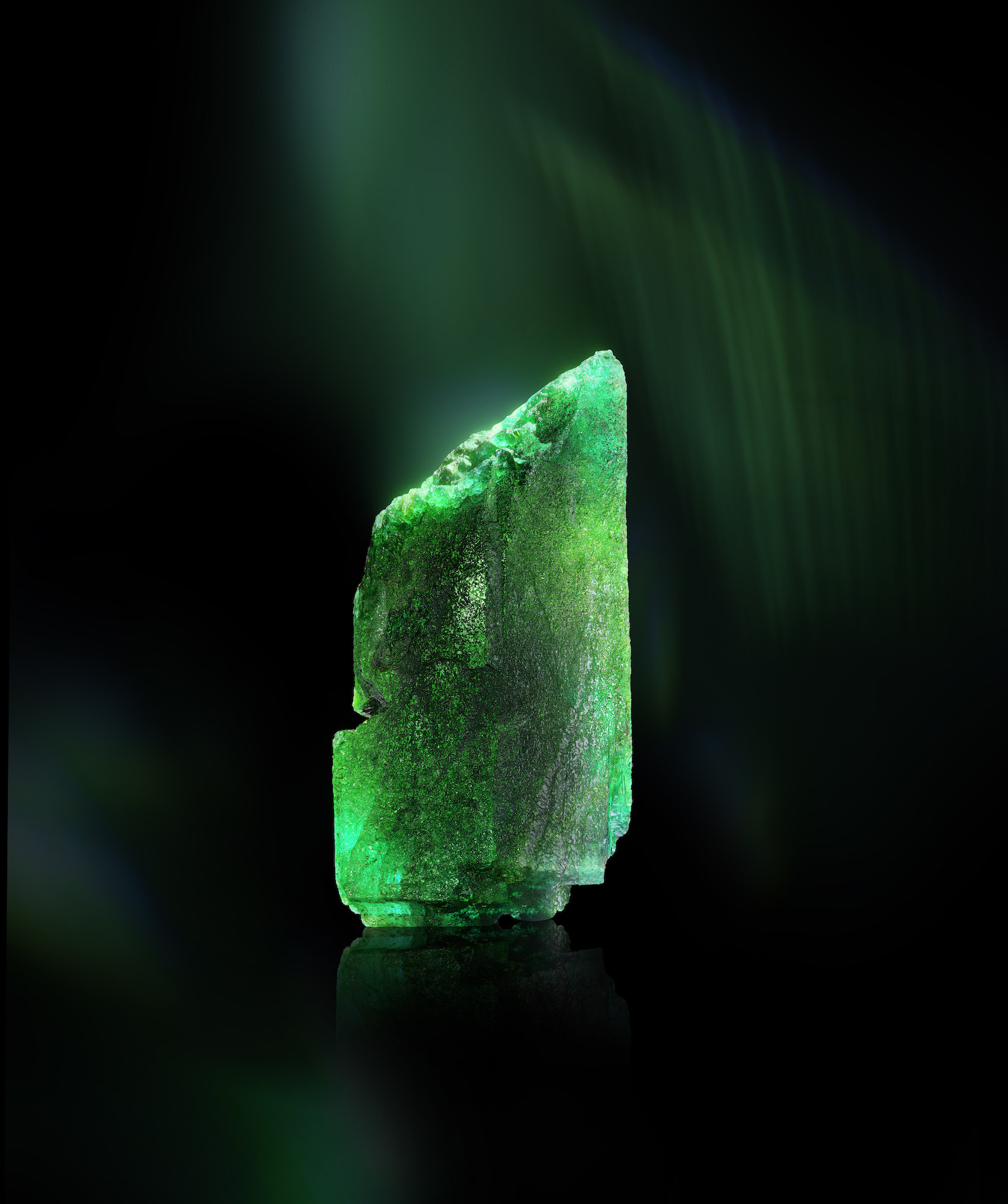
The Insofu rough emerald, an extremely rare stone weighing 6,225 carats ©Chopard
On that grey day in January 2025, a page of fine jewellery history was written in the Chopard workshops in Meyrin: the unveiling of the first pieces of jewellery created from the Insofu rough emerald, an extremely rare 6,225-carat stone. It was the result of a long process that began in the depths of the Earth in Zambia some 500 million years ago.
But first, let’s go back a few years. This 6,225-carat rough emerald was discovered in 2010 in the Kagem mine.
Eight years later, in 2018, Caroline Scheufele, co-president and artistic director of Chopard, decided to acquire it and named it ‘Insofu’, a word meaning elephant in the Bemba language spoken by the local ethnic group. To cut it, she called on expert gem cutters from Jaipur who are masters of traditional cutting and polishing techniques. They worked on the rough stone in both Chopard’s Geneva workshops and in Jaipur.
Once the stones had finally revealed their beauty, the creative process could begin. This was followed by a profusion of drawings, gouaches, multiple possibilities and brass sculptures, in order to see the final result before moving on to the creation of the Insofu Collection set with these precious gems.
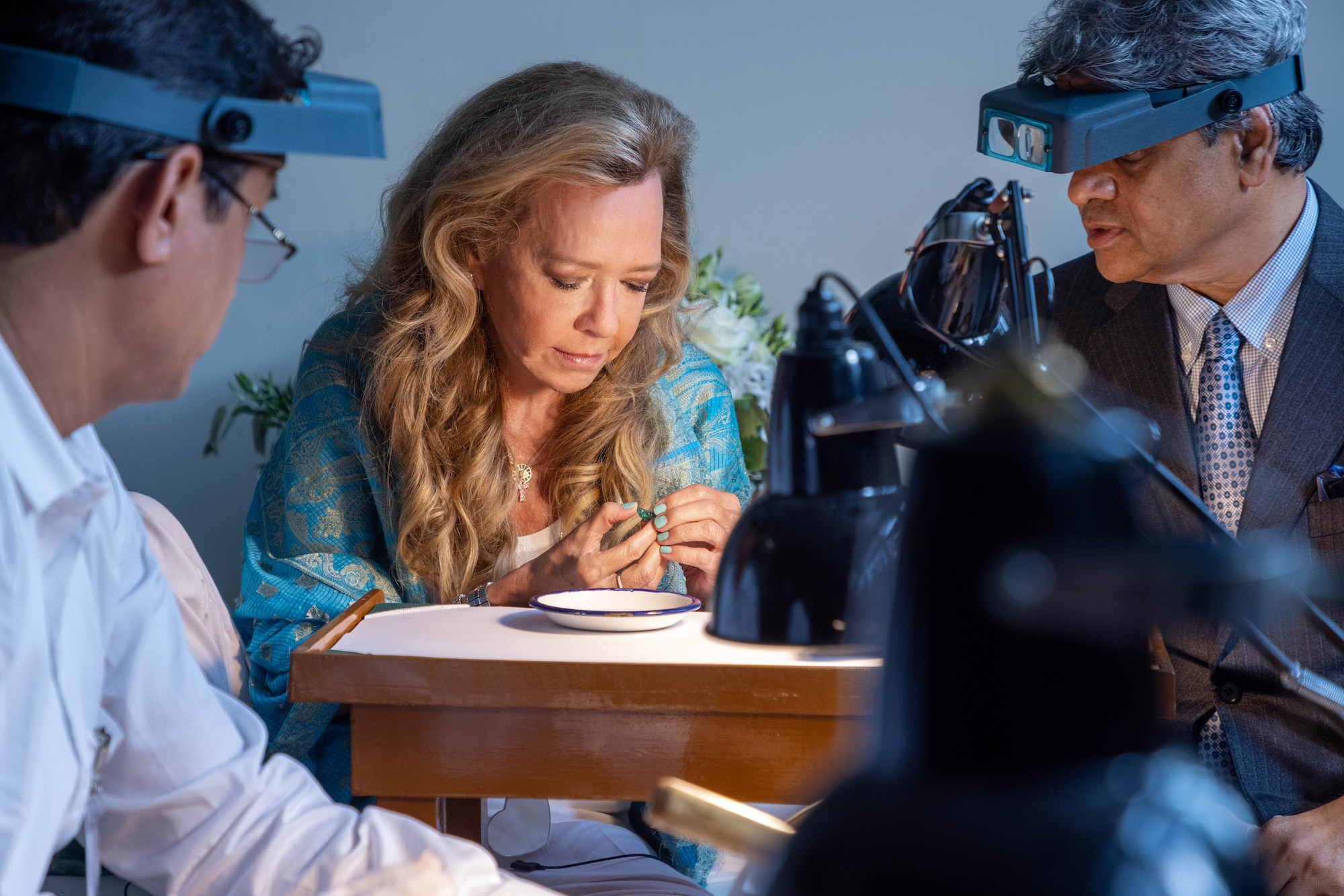
Caroline Scheufele, co-president and artistic director of Chopard, with the expert gem cutters from Jaipur who worked on this rough stone in Chopard’s workshops in Geneva and Jaipur ©Chopard
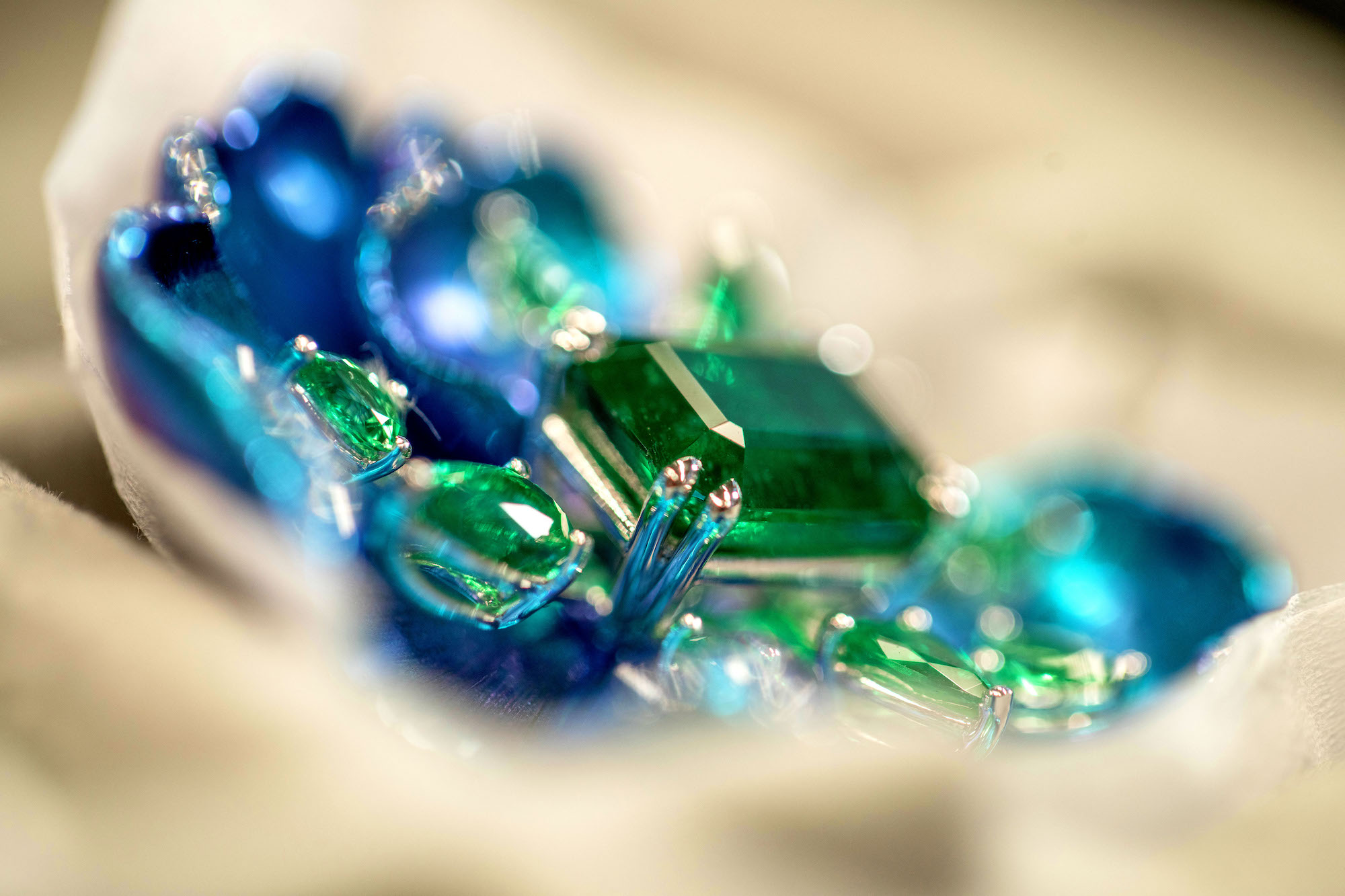
A handful of journalists were invited to preview these pieces at the Chopard workshops in Meyrin. Staring at these beautiful stone-set jewels, everyone held their breath. Among the pieces, a ring set with a heart-shaped emerald was particularly impressive: the stone is a rarity, with a beautiful saturated green colour and almost no inclusions. A pair of fairly classic earrings showcase perfectly matched emerald-cut emeralds, whilst another pair consists of two blue titanium flowers with a magnificent emerald-cut emerald at their centre and pear-cut emerald pistils.
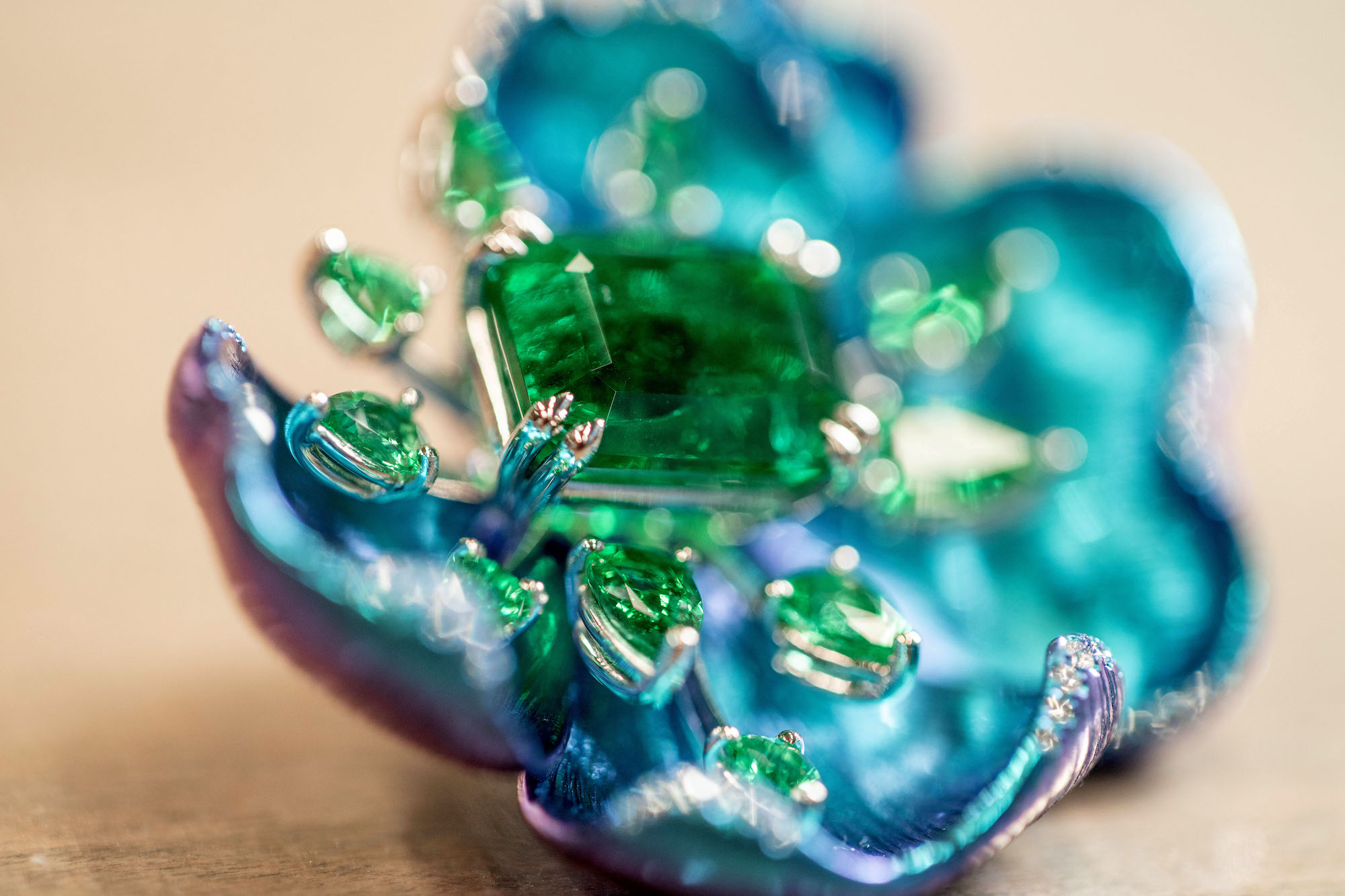
A pair of earrings formed of two blue titanium flowers with a magnificent emerald-cut emerald at their heart and pear-cut emerald pistils ©Chopard
The Kagem mine, one of the largest emerald mines in the world, is operated by the British company Gemfields, with which Chopard signed an agreement in 2016 as part of its sustainable approach, The Journey to Sustainable Luxury. To ensure the traceability of the rough stones produced there, Chopard called on the Swiss company Gübelin, which developed a unique synthetic DNA tracer that can be inserted into the stone directly at the mine to guarantee its origin.
By acquiring this rough stone, Chopard embarked on a journey with an uncertain outcome: emeralds are dark stones whose potential is only revealed once they have been cut. But Caroline Scheufele loves stones too much to avoid taking risks. She tells us about this epic journey.
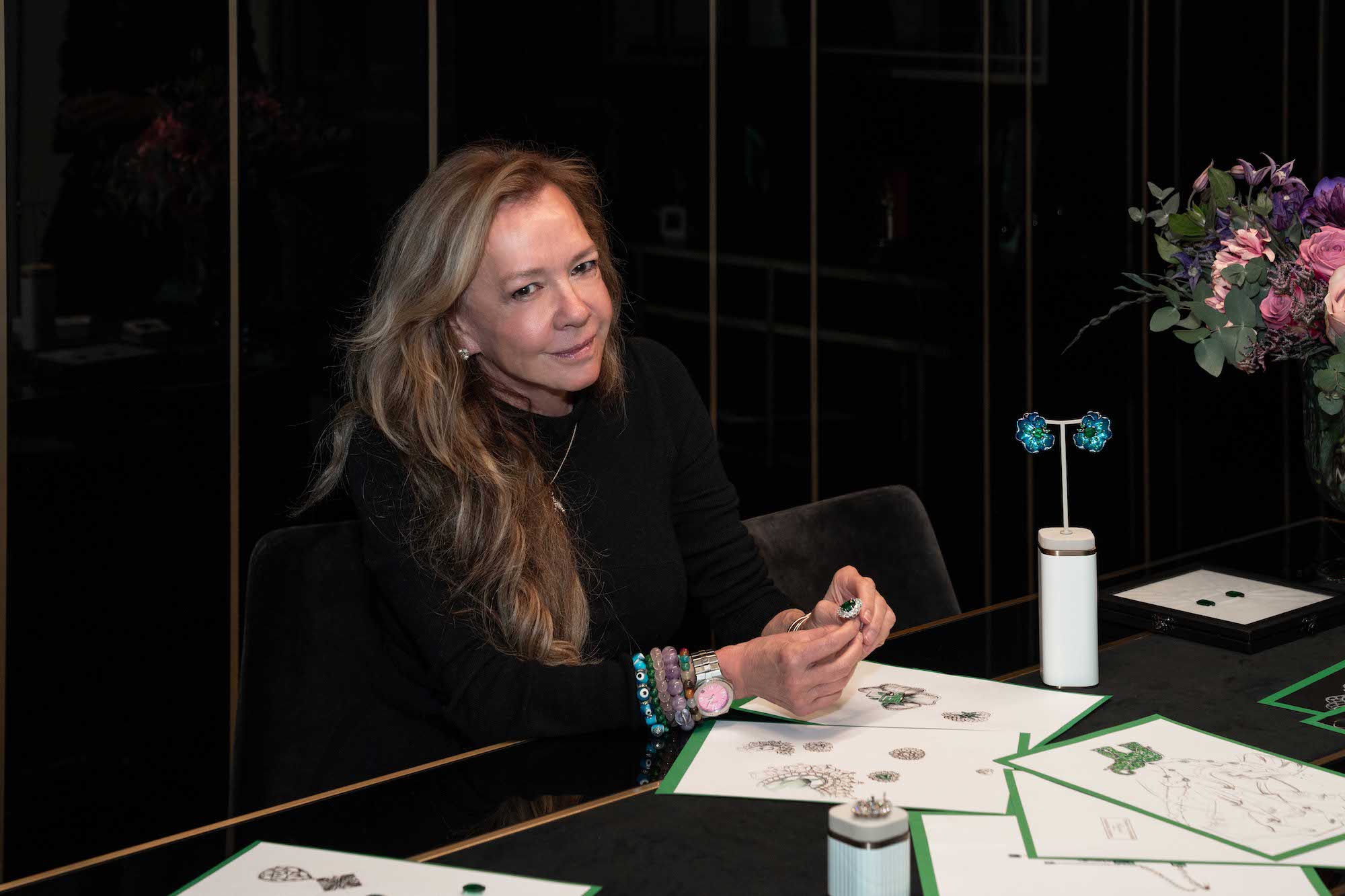
Caroline Scheufele working on the Insofu collection ©Chopard
INTERVIEW
The Insofu emerald was discovered in 2010. Under what circumstances did you acquire it in 2018?
Caroline Scheufele: I knew that this stone was hidden in the safe of a long-time friend and partner. He showed it to me and I told him that something should be done with it. The negotiations took a while because he didn’t necessarily want to sell it. But he knows my passion for stones: he had followed the story we told about the Queen of Kalahari diamond (a rare 342-carat diamond that inspired a collection in 2017, editor’s note) and agreed to sell me this rough stone.
Three exceptional emeralds have been mined from the Kagem mine in Zambia: Insofu, weighing 6,225 carats and discovered in 2010, Inkalamu, weighing 5,655 carats and discovered in 2018, and Chipembele, weighing 7,525 carats and discovered in 2021. Have you seen the other two?
One of these two other emeralds belongs to the same person who sold me Insofu. I’m going to finish this collection first and then we’ll see…
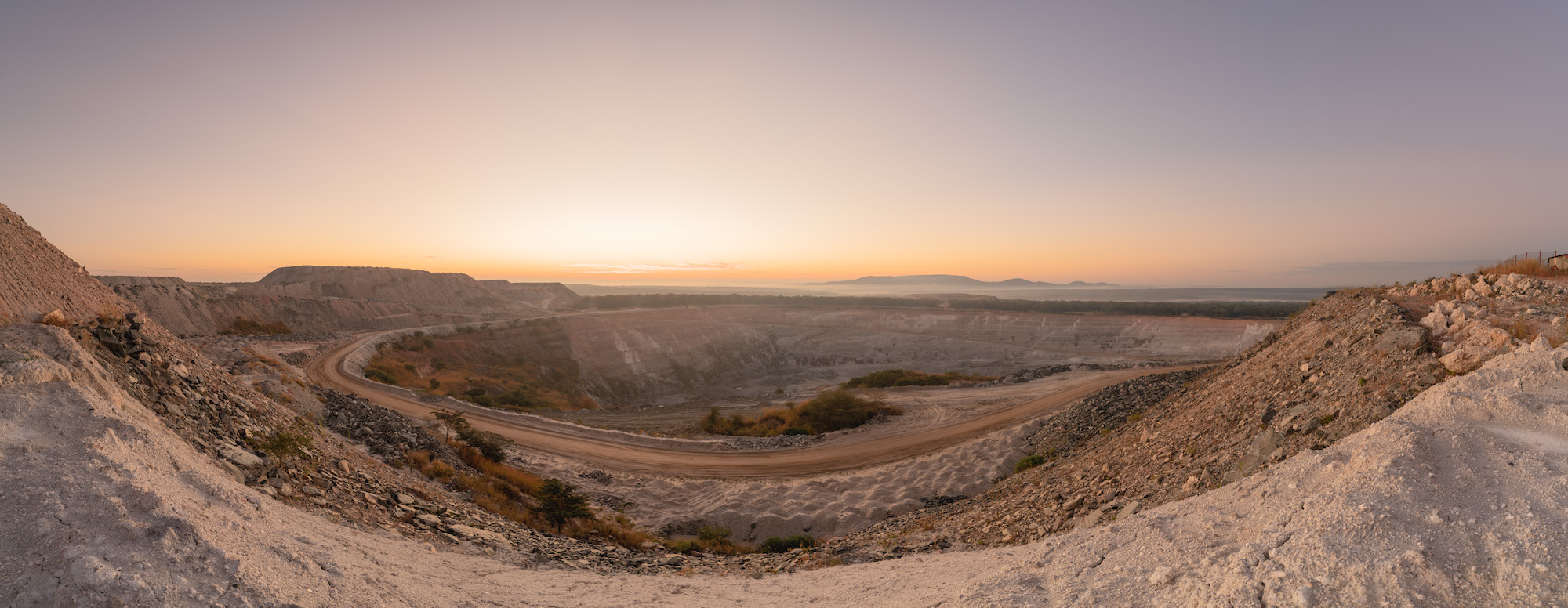
The Kagem mine in Zambia ©Chopard
When you acquire a rough diamond, thanks to technology, you can envisage the best possible cuts, but not with a rough emerald: because of its inclusions, it can break during cutting. How do you assess the risk when making such an acquisition?
You have to be willing to take risks from time to time. When you illuminate the stone with light, you can see green colour all around it, but the centre of the stone remains dark. It’s a bit mysterious. You have to rely on luck. It was love at first sight. I wanted to continue the story of the Queen of Kalahari diamond and write a new chapter with another gemstone.
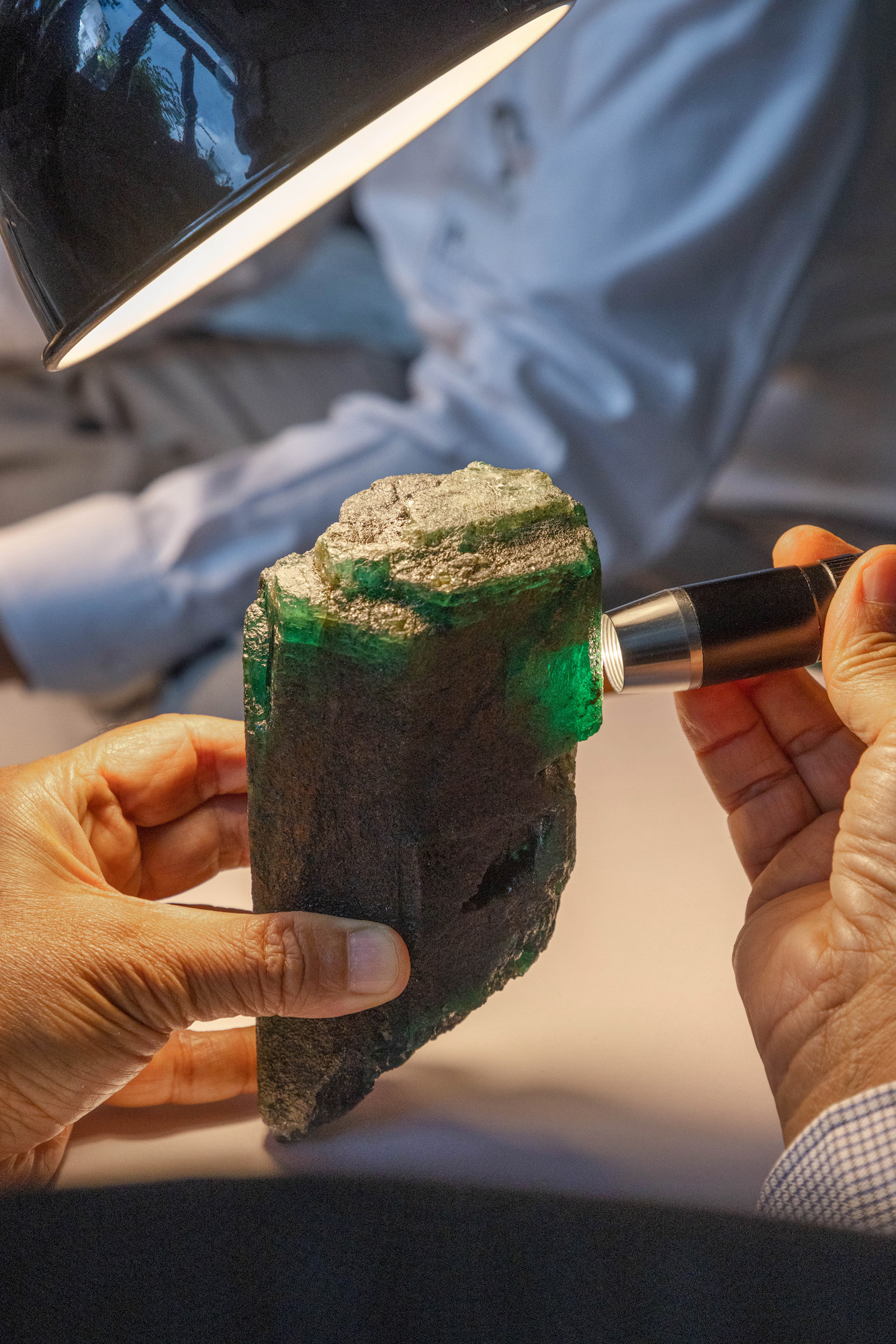
‘When you shine light on the stone, you can see the green colour all around, but the centre of the stone remains dark.’
Did you place your complete trust in the lapidaries for the cutting?
Yes. I called on two Indian lapidaries I knew, who come from a family that has been practising this craft for generations. They learned to look at stones from childhood. One of them started this profession at the age of 15, the other at 17, and they have been cutting stones for 30 years. To understand gems like this, you have to call on the best. They are specialists and you have to trust them.
Did you invite them to Meyrin or did you send the stone to Jaipur?
They came to Meyrin, stayed for weeks, then went back to India, and came back again. It took months. They came with their ancestral tools, which are handmade. In fact, they do everything by hand.
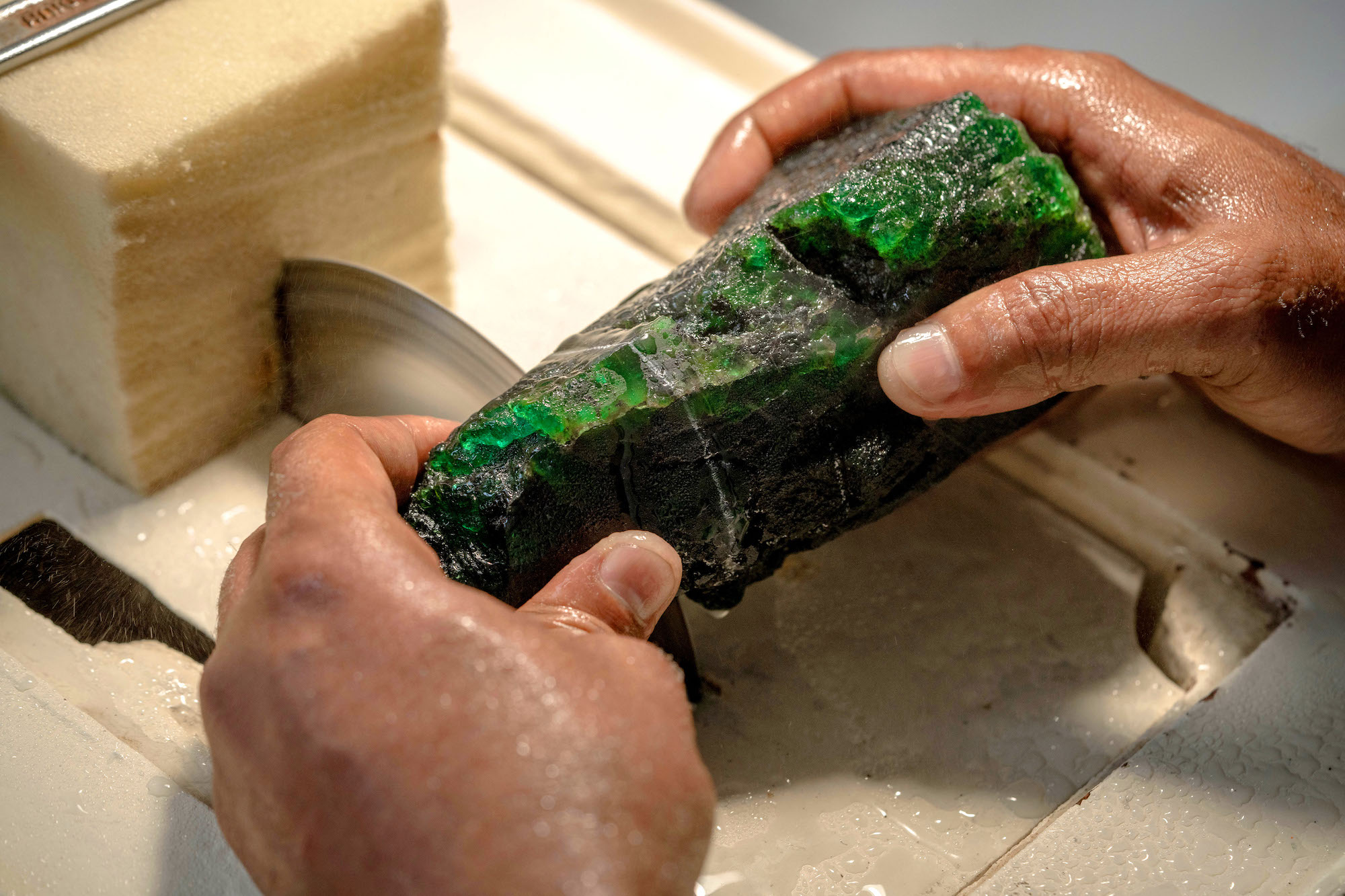
A gem cutter cutting the Insofu ©Chopard
How did you feel when they cut the first piece?
They sat on the floor in the studio for over a week, turning the stone in every direction and discussing it among themselves. At one point, I wondered when they were going to start. (Laughs) In India, we have a different concept of time, and they work according to their culture: you don’t cut an emerald on a Wednesday, for example. One day they told me they were going to make the first cut, so I went there and, of course, the emerald was no longer the same once it had been cut. It was the beginning of a whole new story. The cutting process takes time because it all depends on the eyes and the hand. Emeralds are the most fragile gemstones. If they are cut badly, they can fall apart. They have to be cut little by little.
When you cut a rough stone, there is always a part that cannot be used. How many carats were you able to extract from this exceptional 6,225-carat rough stone?
We managed to obtain around 850 carats of beautiful stones. In the capsule collection, we used 230 of them, some of which have a very attractive green colour, such as the ring with the heart-cut emerald, which is magnificent: its colour is highly saturated and it has almost no inclusions, which is very rare. It is one of my favourites. I must say that it was a very beautiful rough stone and we knew that it would yield some beautiful stones, but again, it was a gamble. You can never be sure of anything in advance.
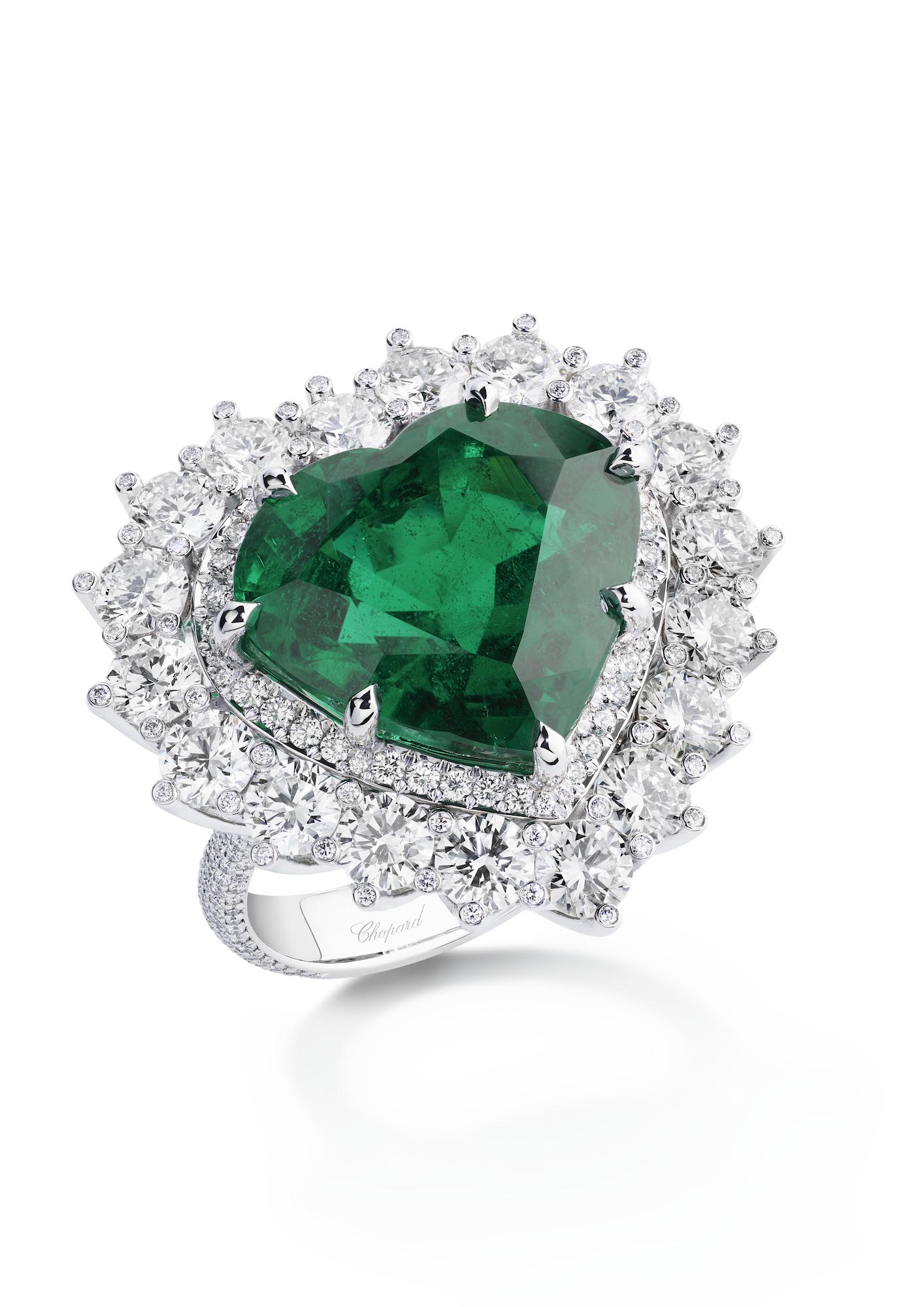
This magnificent heart-cut emerald from the Insofu has a very saturated colour and virtually no inclusions
The first set of jewellery created from this rough stone, co-designed with actress Julia Roberts, was presented at the Watches and Wonders fair in April 2024. This new capsule collection consists of 15 pieces. How many pieces will the entire collection include?
We will complete the collection as we go along with the other stones that have been cut. There will also be watches, and we will use the smaller stones for pavé setting. We acquired this rough stone in 2018, and I needed to start showing some of the beautiful jewellery that came from it, but I can’t tell you yet how many pieces we will create in total.
Very few jewellers buy rough stones. Why is that?
It’s a different profession. It’s quite an adventure. Jewellers generally buy stones that have already been cut at trade fairs such as GemGenève. In my case, it’s also about staying true to our journey towards sustainability.
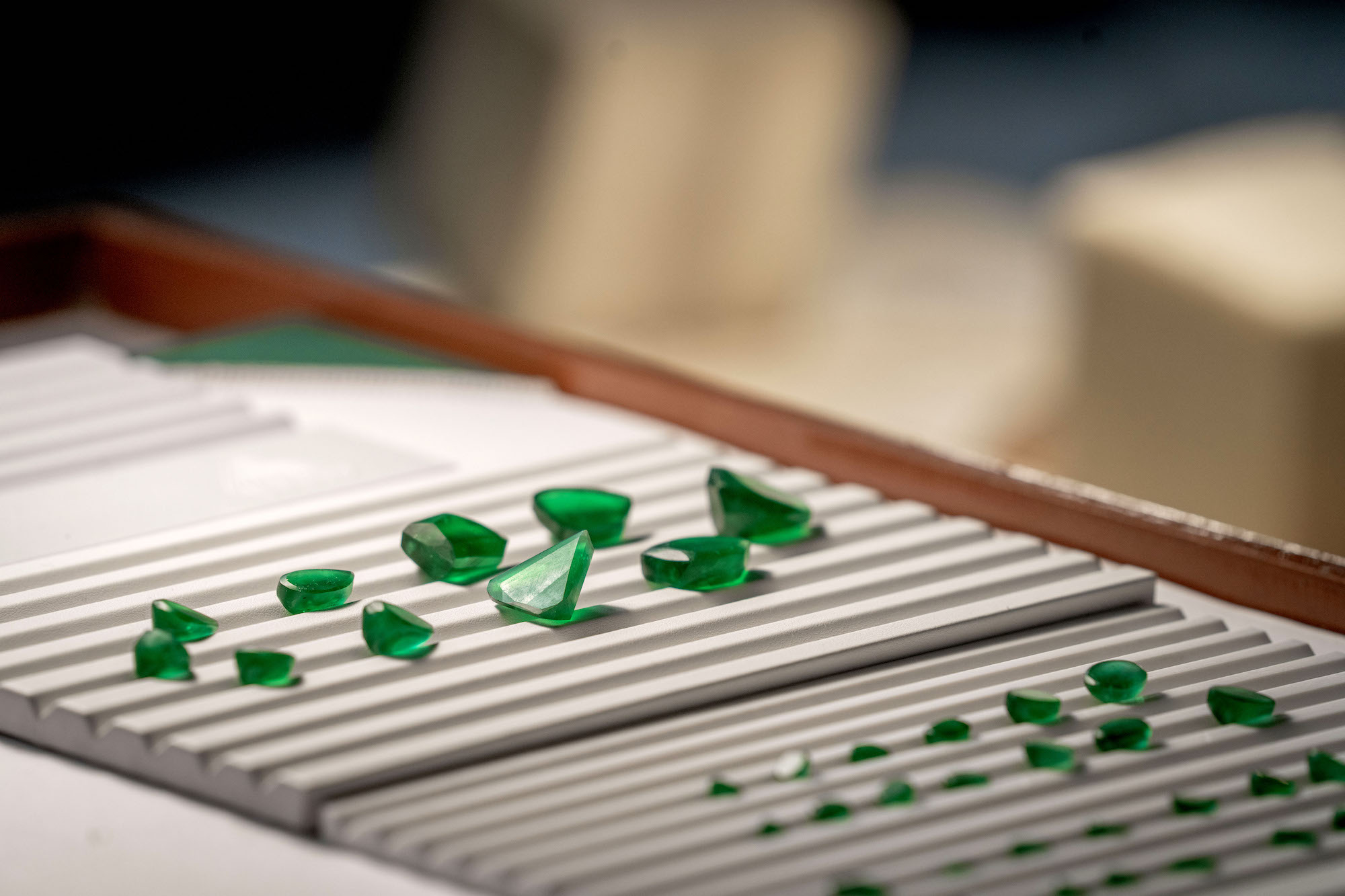
Thanks to the tracer developed by Gübelin (the Provenance Proof structure, editor’s note), it is possible to track every stone from the Insofu emerald.
The advantage of buying rough stones is that you know their origin. Have you had it identified?
We worked with Gübelin, which has developed a DNA tracer (the Provenance Proof structure, editor’s note). Thanks to this new technology, we can track every stone from this rough and know that it was cut from the Insofu emerald. This is important for everyone, including the end customer. It’s not just about buying a piece of jewellery: buyers want to know where the jewellery comes from, its history from the mine to the cut.
Are there other advantages to buying a rough coloured stone?
Yes, it is very difficult to match emeralds and find two stones on the market that are almost the same colour and size, for example to make a pair of earrings. The two pear-shaped emeralds you see here will undoubtedly become a pair of earrings. One of them was slightly larger than the other, so we recut it slightly to create a perfect pair. We have the ability to achieve a perfect match.
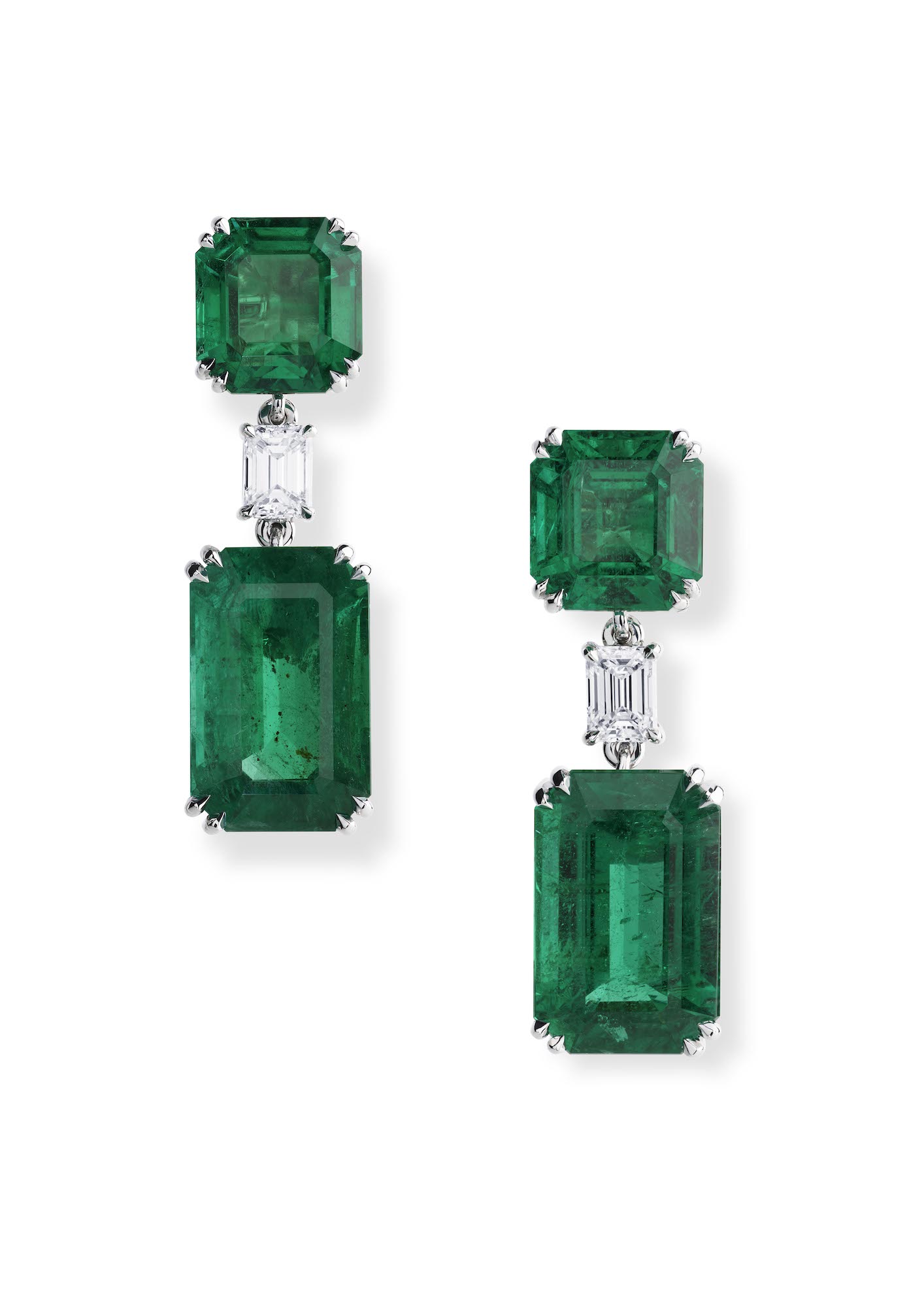
‘It is very difficult to match emeralds and find two stones on the market that are almost the same colour and size to make a pair of earrings.’
You began your journey towards sustainable luxury in 2013. In 2016, you signed a partnership agreement with Gemfields for the acquisition of coloured stones that you have incorporated into this journey (diamonds, Australian opals, Mozambican rubies, Paraiba sapphires). Now 100% of the gold you use is ethical gold. How far do you intend to go to make your profession as ethical as possible?
There is no end. There is still a lot to be done. That is why we have called our approach ‘The journey to sustainable luxury’. The world of coloured and semi-precious stones is vast. I take the same approach with my Caroline’s Couture collections. If I need two metres of fabric to make a dress, I will order two metres and not 25 metres and throw away what I don’t need. My brother is also very involved in this journey. In 2019, he introduced Lucent Steel™, which is recycled steel that we use to make all our steel watches. But all this doesn’t happen overnight. You have to find the right partners. There are more and more government controls and more and more regulations. At Chopard, we started early and so we have a slight head start.
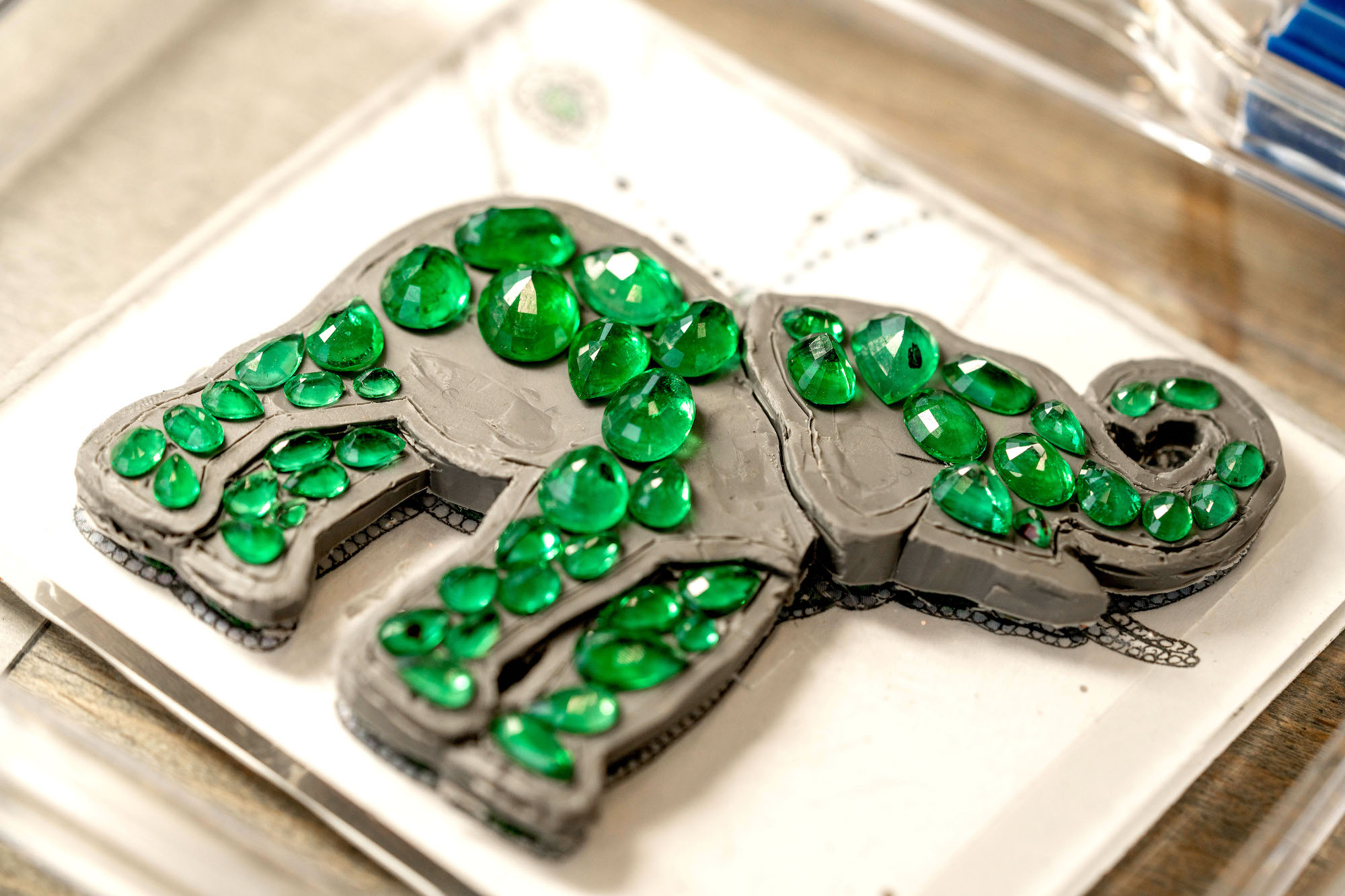
Making of the elephant-shaped pendant. Insofu means elephant.
When you started designing this collection, what was the first piece of jewellery you thought of?
The elephant-shaped pendant with its trunk pointing upwards, which is considered a lucky charm. It can also be worn as a brooch. Insofu means ‘elephant’ in the Bemba language. It was a way of paying tribute to its origins. We were supposed to present the collection in Los Angeles for the Oscars, but after the fires that ravaged the city, it would have been in very poor taste. We will be presenting the collection in Paris during Fashion Week and then in London. Part of the proceeds will be donated to the Elephant Family charity. Their Majesties King Charles III and Queen Camilla are the presidents of this charity, which is dedicated to the preservation of endangered wildlife species in Asia.
How do you feel you are paying tribute to this stone with this collection?
I try to create pieces that live up to the raw material, that possess just as much magic and mystery.
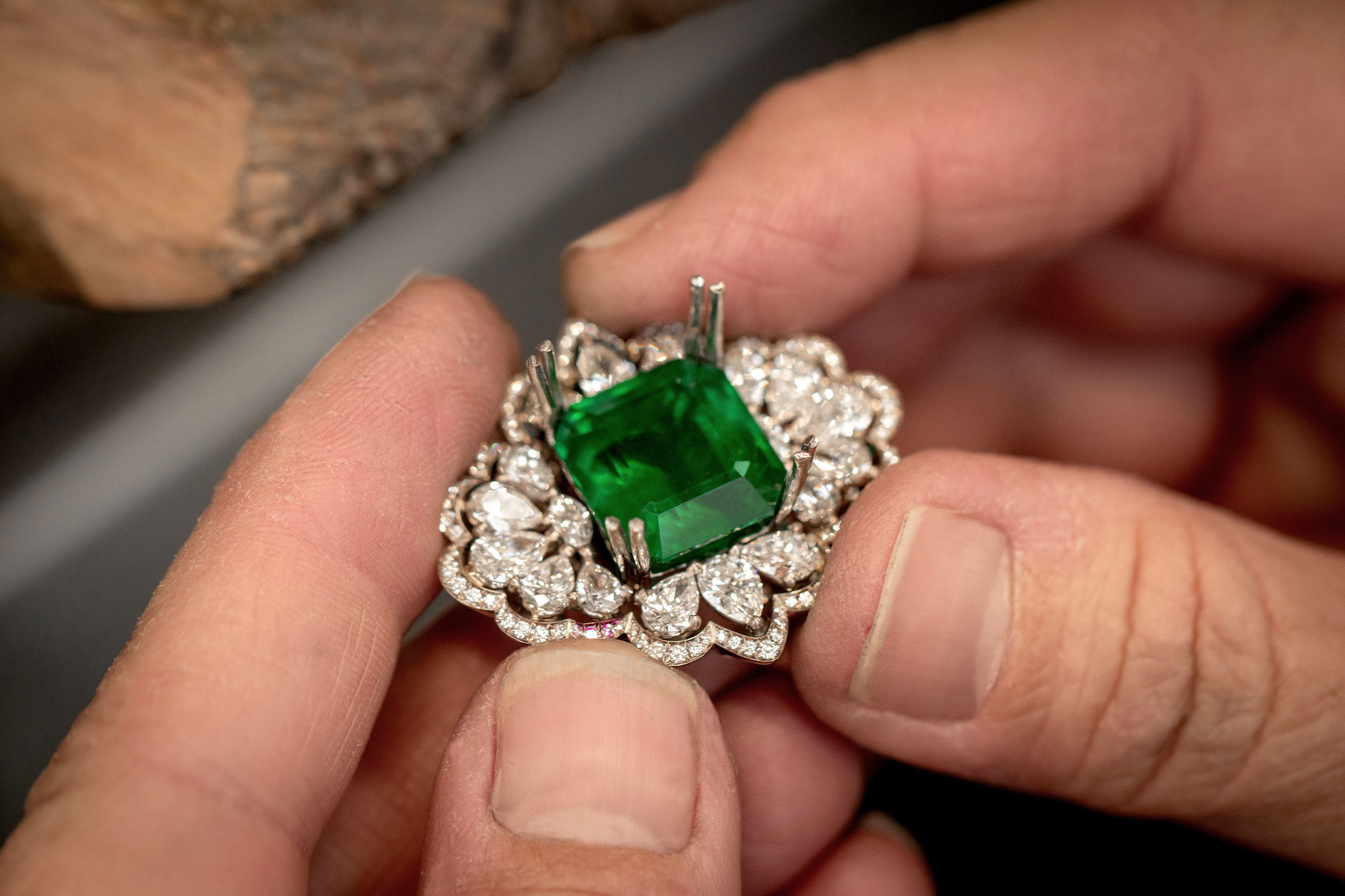
Making of a piece of jewellery from the Insofu collection. ©Chopard
How do you feel when you see beautiful cut emeralds like these?
Emeralds are my favourite coloured stones. Their green colour evokes nature. Emeralds are full of life: when you look closely, you can see inclusions called “gardens”. Imperfection can be very beautiful! Emeralds are fragile. They must be treated with care.
And what will the next episode of this journey around rough stones tell us?
There are four precious stones: diamond, ruby, sapphire and emerald. We have already written a story about diamonds, and this one is about emeralds. For the next one, I would like to be inspired by a ruby from Mozambique.