
François-Paul Journe tells the full story of the Chronomètre Optimum
Launched in 2012, the Chronomètre Optimum, was twenty years in the making. It took François-Paul Journe “ten years in my head and ten years in the drawers” to bring chronometry back to the heart of high watchmaking. And doing so, he drew on a historic legacy: that of Abraham-Louis Breguet’s natural escapement. Isabelle Cerboneschi

Master watchmaker François-Paul Journe ©F.P.Journe
The Chronomètre Optimum was not born overnight, nor even in a thousand nights. It took the master watchmaker twenty years to develop this timepiece, arguably the one the most clearly places him in the lineage of Abraham-Louis Breguet.
When it was unveiled in late 2012, the Chronomètre Optimum bore little resemblance to the grand complications that had established François-Paul Journe’s reputation. Strictly speaking, it has no complications: it displays the hours, minutes, seconds and power reserve. Yet paradoxically, it is one of the most complex movements ever conceived for a seemingly simple watch. Its complexity lies at the very heart of time measurement.
The first drawings for the wristwatch date back to 2001. François-Paul Journe had set himself three objectives: to reduce friction, to deliver the most constant possible force to the escapement in order to promote isochronism, and to eliminate the need for lubrication in the escapement to ensure its long-term stability. To achieve this, he drew inspiration from Abraham-Louis Breguet’s natural escapement. Unlike Breguet’s mechanism, however, which could not start spontaneously, François-Paul Journe developed a direct-impulse escapement capable of starting on its own: the patented High-Performance Bi-Axial Escapement.
The Chronomètre Optimum can be regarded as a masterpiece of modern chronometry, in that it offers solutions to several fundamental problems that confronted the great watchmakers of the past. François-Paul Journe did not invent constant force, direct impulse or the double barrel. Instead, he developed a new horological architecture in which these inventions reinforce one another. In doing so, he partially resolved a question that preoccupied the great chronometrists of the eighteenth and nineteenth centuries: how could the oscillator be protected from irregularities in the energy that drives it? With the Chronomètre Optimum, he demonstrated that the boundaries of pure chronometric research could still be pushed further.
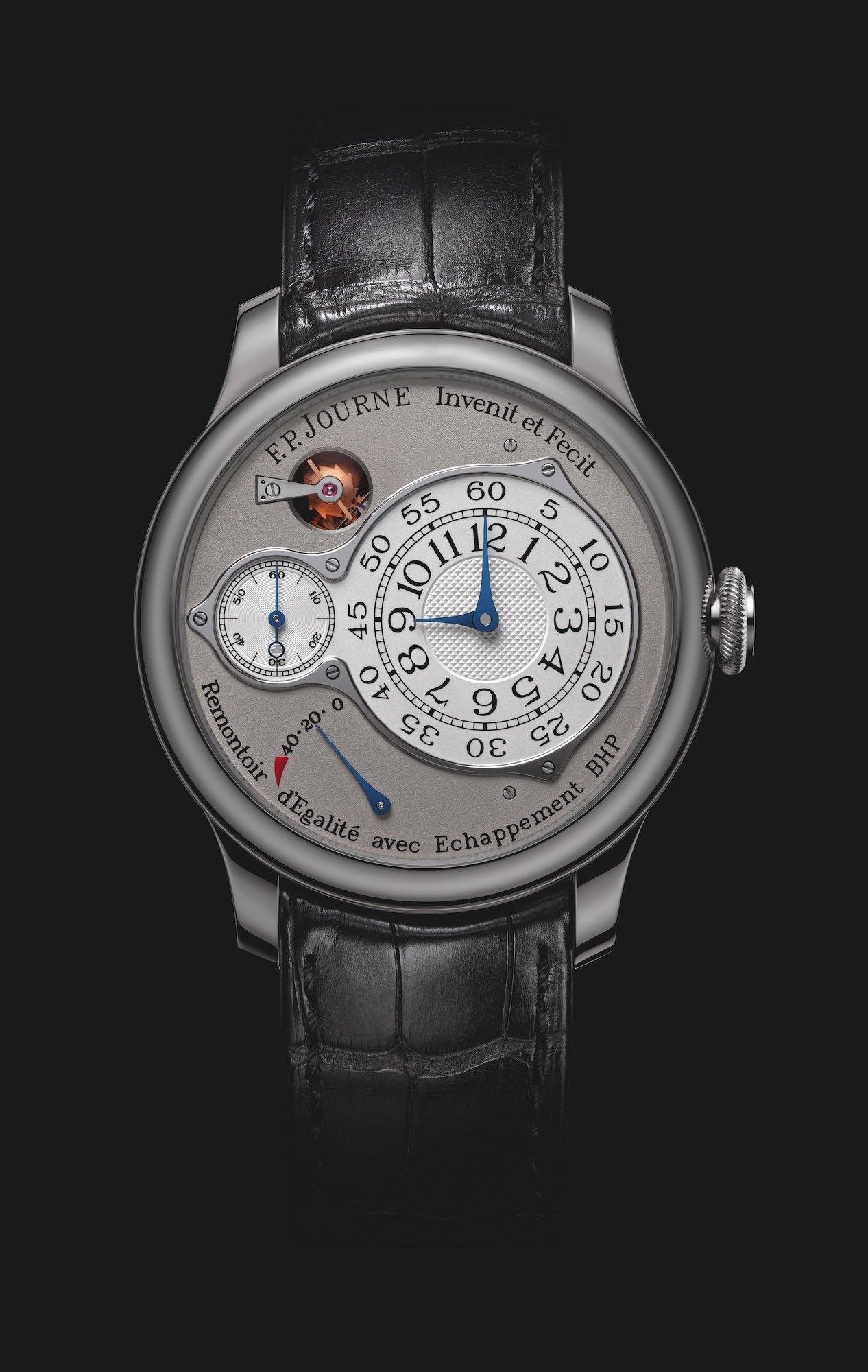
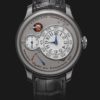
F.P.Journe Chronomètre Optimum
INTERVIEW
The Chronomètre Optimum embodies the very essence of your research into chronometry. Was there a particular moment when you said to yourself, “This is what the ideal chronometer should be”?
François-Paul Journe : It was in the late 1980s. I had already made three or four pocket watches, and I told a friend that if I were to make another watch for myself — something I had never had the time to do — it would have the architecture of what eventually became the Chronomètre Optimum, with its special escapement, remontoir d’égalité and everything else that goes with it.
The idea stayed in the back of my mind, and in 2001 I began working on the watch. I drew up the chronometer I had in mind as a wristwatch, but I had so many other things to do at the time that I put it aside. In 2009, I decided to return to it. By then, however, we had made considerable technical progress, so we had to revisit all the existing plans and adapt them to our new working methods.
The Chronomètre Optimum was launched in 2012. It had been in the making for just over twenty years: ten years in my head and ten years in the drawers.
Was there a particular trigger that prompted you to return to the project in 2009?
Economic circumstances prompted me to launch it, particularly the subprime crisis. Tourbillons and watches above a certain price were no longer selling, so I had to come up with something new. When the Chronomètre Optimum was launched, it cost around CHF 85,000, considerably less than a tourbillon.
I’ve never asked you this before, but have you ever abandoned a project?
No, never. But before starting a project, I spend a long time thinking it through. I’m not going to set out to climb Everest barefoot (laughs). There have been times when I felt discouraged, when I was working on a watch and couldn’t figure out how to make it work, but I’ve always carried on. Sometimes you feel as though you’re working without knowing where you heading, but one day you begin to glimpse new ideas.
Which model challenged you the most?
There have been several. First, the pocket watch I made in 1986, because it had an entire system of remontoirs d’égalité, with a fusée, a chain and so on. I should point out that it was difficult at the time. Today, I could make it with my eyes closed. The watch I struggled with most was undoubtedly the Perpetual calendar with instantaneous jump. I couldn’t get it to block. The jump takes place in sixteen thousandths of a second. You can’t see anything with the naked eye. You can only try to interpret what’s happening, and none of the solutions worked. Sometimes we had to go back to an earlier stage, or spend two days on a problem. It took me about seven months to tame it. I also encountered difficulties in finalising the escapement of the Chronomètre Optimum, because we had considered several different versions.
In a sense, the Chronomètre Optimum represents a dialogue across the centuries with the great watchmakers of the past. If you could bring Jost Bürgi, Ferdinand Berthoud, Abraham-Louis Breguet and Antide Janvier together around a table — as in the painting given to you by the collector Osama Sendi (The Journe Guy) — which of them would most readily recognise his own research and thinking in the Chronomètre Optimum?
I think they would all understand it, because the Holy Grail for every watchmaker is to achieve constant force. In reality, it doesn’t exist, because you would have to overcome all the imperfections of the balance spring. Jost Bürgi might not understand the oil-free escapement, because in his day people didn’t have the same awareness or knowledge of oils. It wasn’t until the late eighteenth and early nineteenth centuries that watchmakers began to understand that oil was an obstacle they needed to overcome.
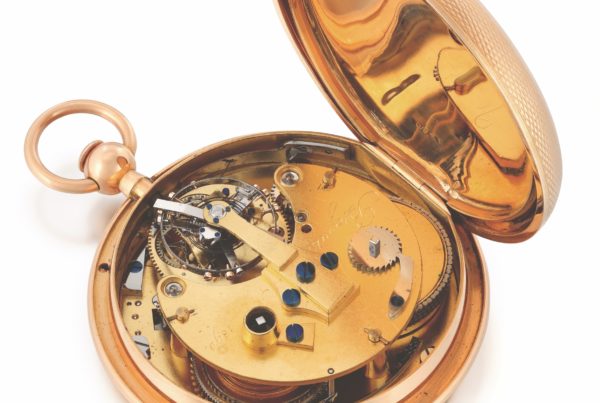
All the more so because, at the time, the oils used were often of animal origin. They weren’t very stable and could solidify when exposed to a sudden change from hot to cold. Breguet’s tourbillon, for example, allowed the oils in the escapement to circulate, preventing them from solidifying.
Would any of these masters recognise a connection with their own horological legacy?
The two most likely to recognise that connection would be Abraham-Louis Breguet and Louis Berthoud, the inventor of modern chronometry. Before him, around 1750, Pierre Le Roy had laid the foundations of chronometry. Building on these foundations, Louis Berthoud created a small chronometer with compensated balance wheel, a cylindrical hairspring, a detent escapement and a fusée.
For almost two hundred years, Louis Berthoud’s chronometers were considered the benchmark, until marine chronometry was phased out in the 1970s and 1980s. Before that, even though GPS and electronic clocks were already being used in the navy, a marine chronometer was always kept on board in case of a failure. Then, when they were no longer needed and the marine chronometer became obsolete, production ceased and the companies that made them went bankrupt.
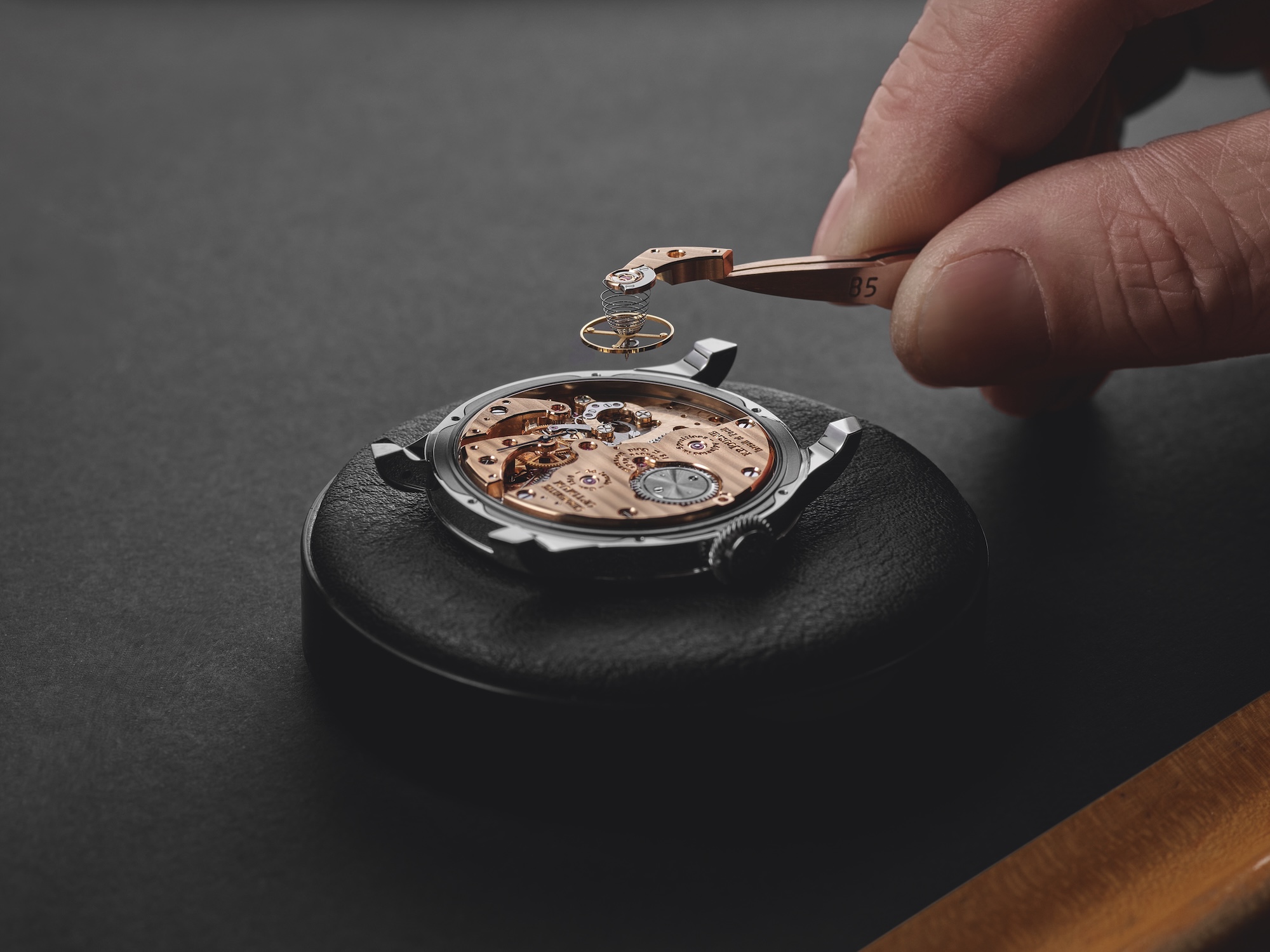
“The Optimum’s escapement is a hybrid between the natural escapement and the lever escapement. Unlike the natural escapement, it is self-starting”.
Your oil-free High-Performance Bi-Axial Escapement was inspired by Abraham-Louis Breguet’s so-called “natural” escapement, but reimagined using modern materials and tolerances. Why did you want to return to Breguet’s natural escapement? Was it a tribute, or were you convinced that this approach deserved further development?
When I first began thinking about this watch, I was immersed in studying Breguet’s work. In the storerooms of the Musée des Arts et Métiers in Paris, I had discovered a beautiful chronometer with a Breguet natural escapement, housed in a hexagonal wooden case. I was fascinated by that escapement. You can really feel that the impulse is more direct in a natural escapement than in a detent escapement. To give you an idea, the natural escapement delivers a series of slaps, whereas the detent escapement always slaps the same cheek (laughs). There is more resistance in a detent escapement because you have to overcome the force of two springs: the detent spring and the return spring. That requires a great deal of force, whereas a natural escapement doesn’t have that problem. The Optimum’s escapement is a hybrid between the natural escapement and the lever escapement. Unlike the natural escapement, it is self-starting. A contemporary watch must be able to start again when it is wound after stopping. Imagine being sold a car with a hand crank in 2026!
It is an escapement with two escape wheels, each delivering a direct impulse alternately. I designed a hybrid system: the lever carries two locking pallets, each holding one of the wheels, with a draw effect similar to that of the Swiss lever escapement. The impulses are transmitted directly from the escape wheels to the roller attached to the balance, without passing through the lever. At rest, neither locking pallet blocks the wheels. When the mainspring barrel is wound, the escapement wheels begin to turn and deliver an initial impulse to the balance, setting the watch in motion.
Each of your watches represents another link in an ongoing quest for precision, allowing you to take your research a step further. The Chronomètre Optimum could not have been created without your work on the remontoir d’égalité, which also inspired the Tourbillon Souverain with Deadbeat Seconds. What comes next?
The current Chronomètre à Résonance, with one barrel, two gear trains, two remontoirs d’égalité and a lever escapement, is my most accurate watch. To improve its precision further, the next step would be to equip it with a new escapement that is small and, I hope, more efficient than the lever escapement, while operating without oil.
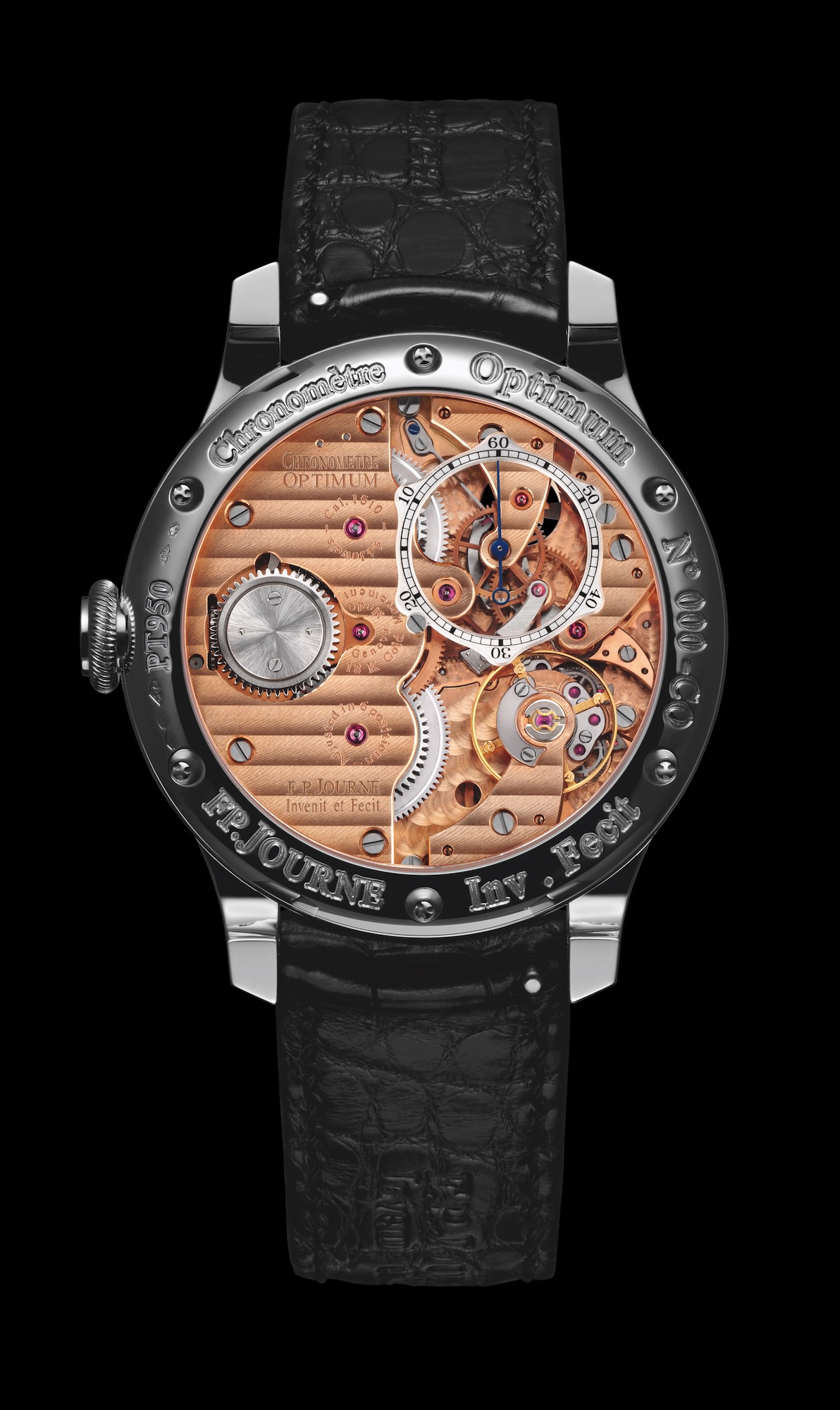
F.P.Journe Chronomètre Optimum
A few years ago, you began telling me about your research into a new escapement. Can you talk about it now, or is it still too early?
It’s too early. Initially, I had designed the Chronomètre à Résonance with this escapement, but I abandoned the idea almost immediately because there were too many unknowns: the remontoir d’égalité was an unknown, and so was the transmission through the differential. At least with a lever escapement, I know its efficiency. I can measure the amplitude, and I know that everything upstream is working properly. If I introduced a new escapement, I would no longer have a point of reference. First, I need to evaluate this new escapement, make sure it works properly and establish that its efficiency is greater than that of the lever escapement. Only then can I consider incorporating it into this model.
Have you reached the testing stage?
Yes, I’ve been testing it for some time, but I’m not satisfied with it. It has everything it needs to work, but it doesn’t work properly. Once it does, I’ll use it in our simplest watch, the Chronomètre Souverain. Then, if it performs really well, we’ll incorporate it into all our movements. That would mean redesigning the entire architecture of our watches, but nothing is impossible.
“Nothing is impossible.” Is that your motto?
Let’s suppose that today I decided to remove the lever and one of the escape wheels, change the balance staff and create a different transmission. That’s perfectly possible, but would the result be any better? Come to think of it, perhaps I should give it a try (laughs).
Connoisseurs regard the Chronomètre Optimum as your masterpiece in the field of chronometry. When you look at it today, do you see everything you have achieved, or everything that still remains to be explored?
There are always things left to achieve, because perfection in watchmaking doesn’t exist. Even though the Chronomètre Optimum works well, there is still room for improvement.
Is this new escapement you’re working on something of a Holy Grail?
I started working on this escapement a few years ago, then stopped, and not long ago I returned to it. I’m trying to understand why it loses seconds. I don’t know why. It has nothing to do with the adjustment. According to the kinetics of the mechanism, it shouldn’t happen, and yet it does. There must be an explanation, but I haven’t found it yet…