
Hermès H08: the keys to its success
In 2021, Hermès launched the Hermès H08, a sporty watch that quickly became a hit thanks to its distinctive design language. With the Hermès H08 Skeleton, launched in 2026, the House took this geometric exploration even further: form becomes function. How did this model establish itself in the sports watch market in such a short space of time? A success story reviewed. Isabelle Cerboneschi
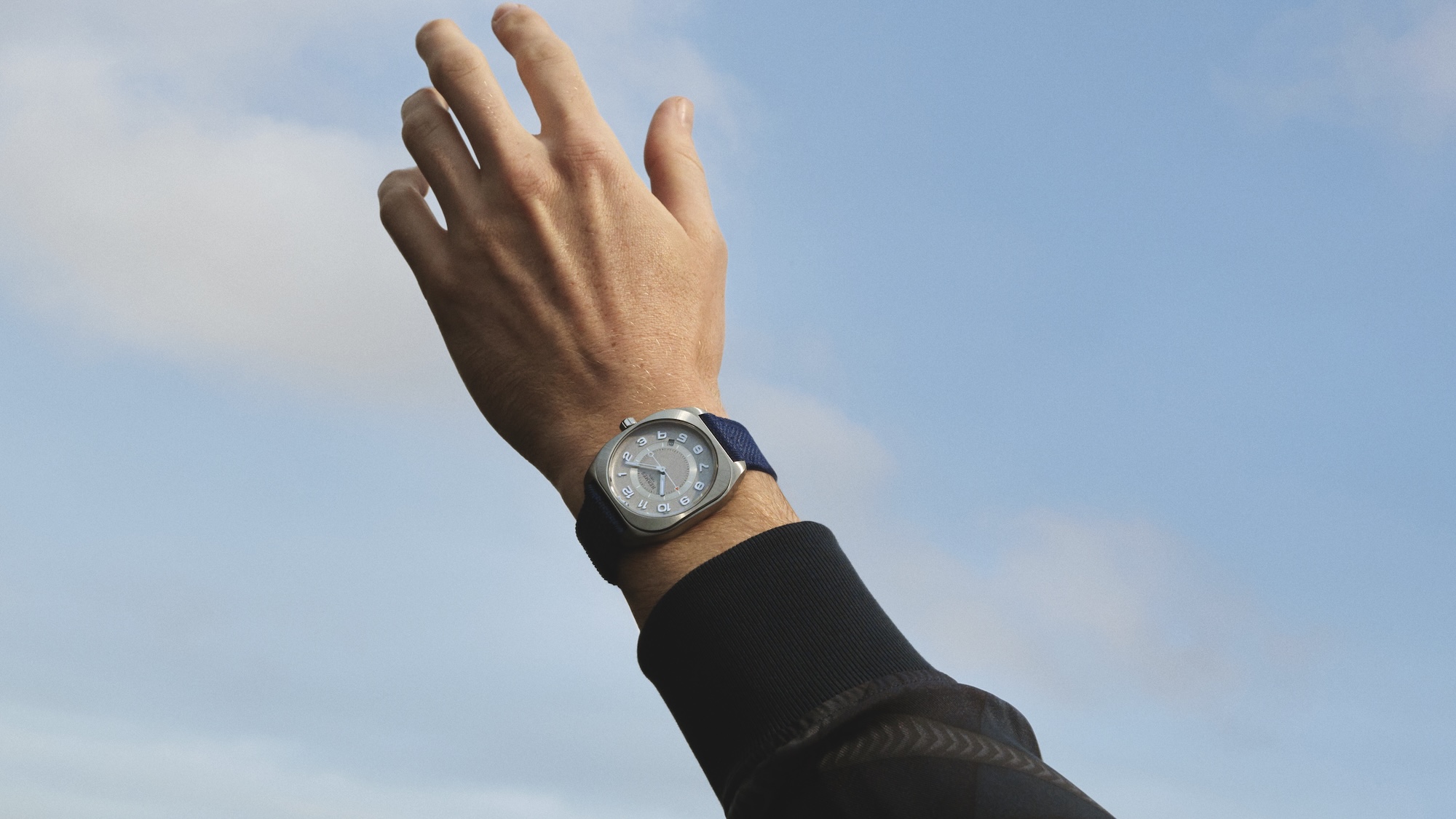
When the Hermès H08 was launched in 2021, it made a highly notable debut. It is not every day that a watchmaker seeks to make its mark in the sports watch sector. Nor is it every day that it succeeds. The popularity of this model in the very year of its launch proved that boldness pays off.
On 1 August 2021, Esquire Australia ran the headline: “This Hermès watch is now selling faster than Birkin bags”. This success had a direct impact on the House’s finances. In its official press release on the 2021 results, Hermès emphasised that “The Watches business line (+121% and +80% over two years) confirmed its excellent performance, reflecting the technical watchmaking expertise and creativity of the collections, with the success of the new Hermès H08 men’s watch, featuring a geometrical and sporty design”. Morgan Stanley’s annual report went on to describe Hermès as “the fastest-growing Swiss watch brand of all”. Five years after its launch, the Hermès H08 has become a well-established line within the House’s portfolio.

To fully understand the reasons behind this rapid success, it is worth taking a look back at the past. Over two decades, Hermès has demonstrated that watches are not merely accessories. The company gradually established itself as a watchmaker, first by acquiring a strategic 25 per cent stake in Vaucher Manufacture Fleurier in October 2006 – which it increased to 40 per cent in early 2026 – then by integrating Natéber SA’s dials in April 2012 and Joseph Erard Holding’s cases in November 2013, and finally by bringing this expertise together at its manufacture in Le Noirmont.
Hermès took the watchmaking world by surprise in 2011 by partnering with Agenhor to launch ‘Le temps suspendu’, an unexpected complication offering a unique way of telling the time. The Slim d’Hermès Perpetual Calendar won an award at the GPHG in 2015, whilst the Arceau L’heure de la Lune, created in partnership with Chronode in 2019, had won over collectors; and now no one is surprised to see minute repeaters bearing the Hermès name on the dial. ’Hermès Horloger’: the name says it all.
However, Hermès was missing a true sports watch – one that was elegant and contemporary, and capable of spawning a new collection. The House could have drawn on a historic model and added some of the usual hallmarks of sports watches, but that was not the path it chose. It created a new shape for the Hermès H08 and set about ensuring this model became part of the brand’s heritage through everyday wear.

When form becomes a language
“The initial brief was to create a contemporary watch – slightly rebellious, versatile – that would form part of Hermès’s menswear universe. We also wanted to create a true mainstay of our men’s range – a watch with a sporty, geometric and architectural spirit, without falling back on traditional watchmaking conventions,” explained Philippe Delhotal, Creative Director of Hermès Horloger, at the launching of this watch. This was a bold move, as the Hermès H08 had to find its place within a lineage of sports watches that first appeared in the 1970s and became icons thanks to certain instantly recognisable features: the distinctive shape of the bezel, the visible screws and the integrated strap.
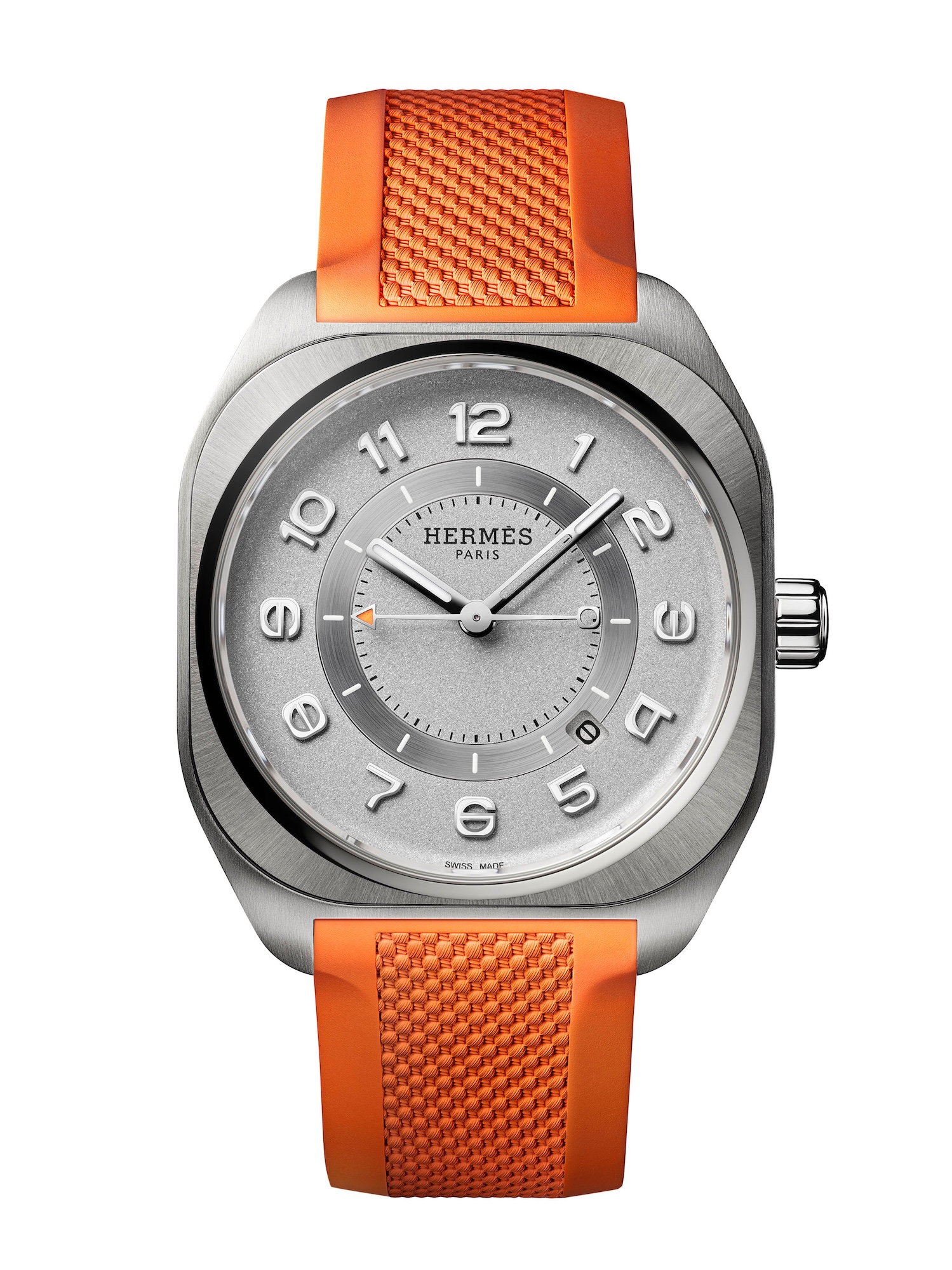
Yet the Hermès H08 seems to have absorbed fifty years of sporty-chic watchmaking without having to rely on specific design codes and with no apparent effort. It possesses something that is very difficult to achieve: a silhouette and proportions. Just as one recognises a well-tailored garment – the shoulder line, the volume, the drape of the fabric – so too does one recognise the Hermès H08. ‘Form is a language at Hermès,’ emphasised Philippe Delhotal. ‘The objects all have very distinctive shapes that one might describe as “simple”: we tend to take things away rather than add them. ’ For the Hermès H08, the creative director had the idea of layering several simple geometric shapes – the square, the circle, the line and rounded corners – to achieve a harmonious result that is immediately recognisable.
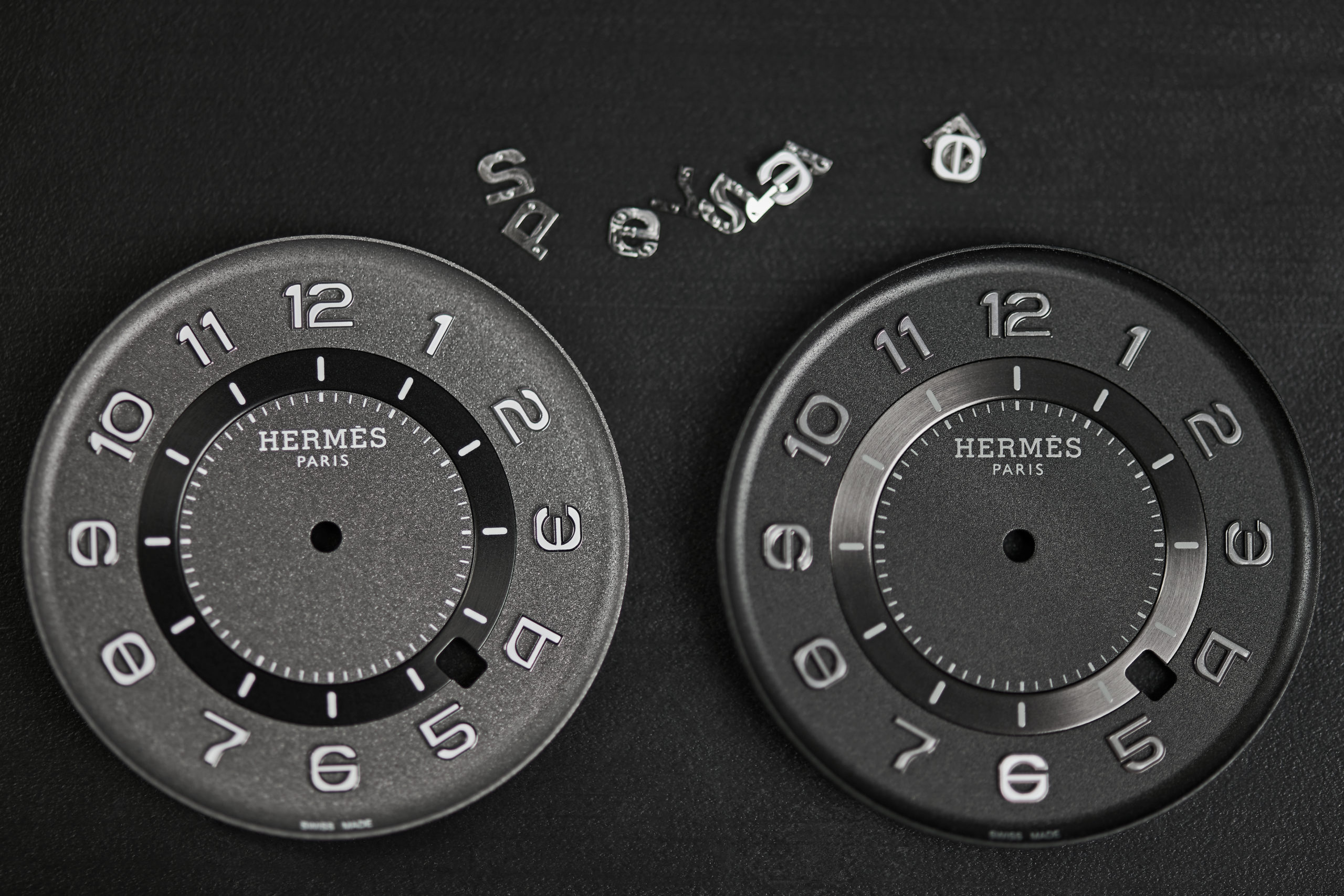
The Hermès H08 has a highly recognisable silhouette with its cushion-shaped case, its lines that are both straight and curved, and a geometry that is reflected even in the typeface created especially for it. The ‘0’ graphically reproduces the contours of the case, whilst the ‘8’ is inspired by the links of the iconic anchor chain, whilst also forming a lemniscate – a symbol of infinity.
The Hermès H08 functions like an alphabet in which several repeated letters ultimately form an identity. This blend of subtle details and this ‘grammar’ of shapes means that, regardless of the materials from which it is crafted — titanium and graphene, rose gold and titanium, titanium and ceramic – or the colours it features – black, orange, steel, Zanzibar blue, abyss blue, dune, medium green, orange, yellow, Saint Cyr blue – it retains its identity and elegance.
Furthermore, this watch embodies several principles characteristic of the Hermès men’s collection: luxurious technical materials, comfort, minimalist approach, understated luxury, colours used as accents, and a blend of sportiness and sophistication. Even the strap has been specifically developed for this model to achieve a sporty yet refined look.
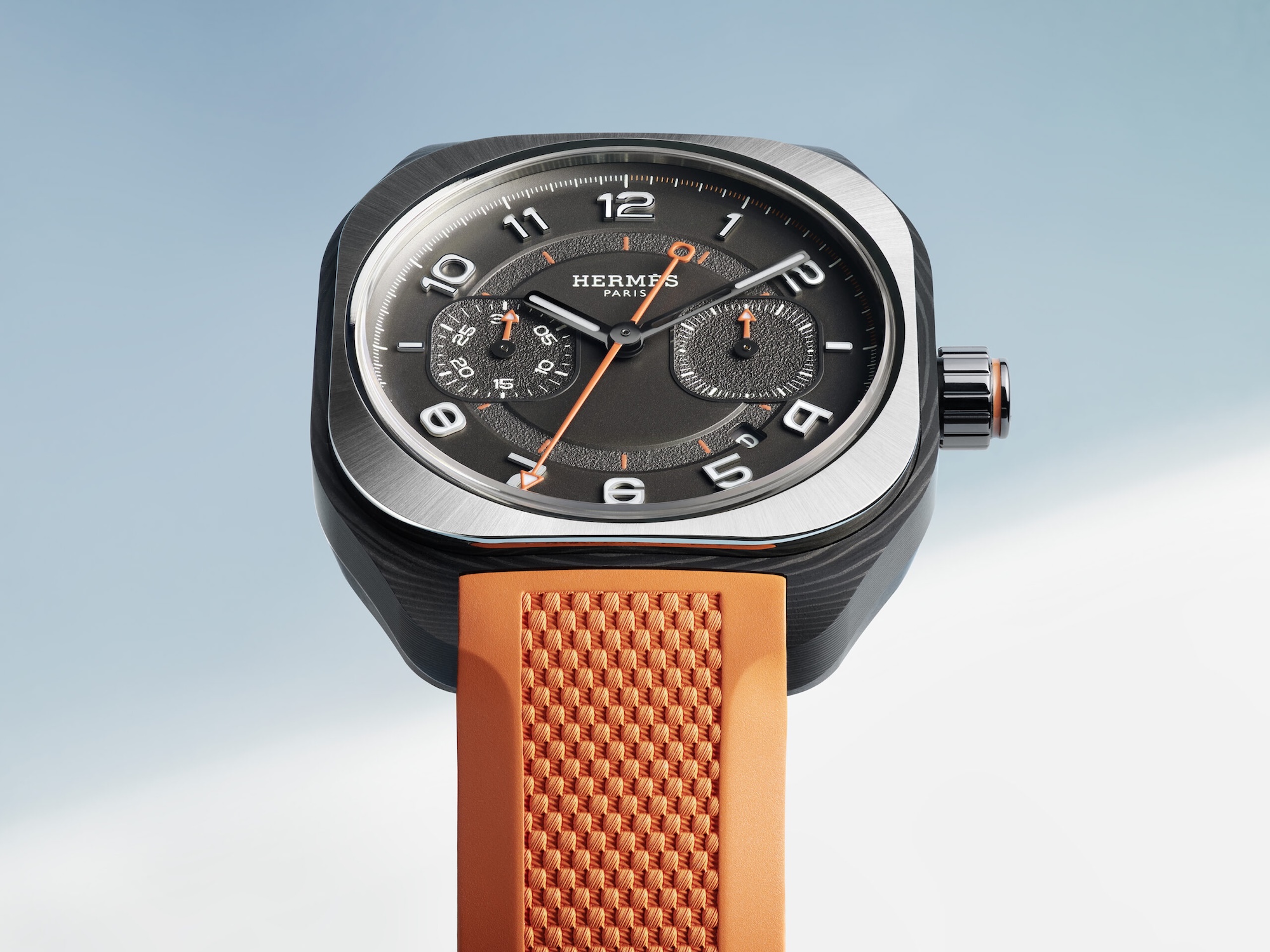
The single-push-button chronograph: in pursuit of simplicity
The Hermès H08 was created to last, to evolve and to be enhanced over time with new functions and complications. Two years after its launch, Hermès unveiled the Hermès H08 Chronograph. Because the House does things differently, it opted for a single-push-button mechanism. Its case, with its taut lines carved from a block of multi-layered composite made of carbon fibre and graphene powder, evokes the world of brutalist architecture. As Philippe Delhotal is an advocate of removing anything superfluous, every element is exactly where it should be in this model.
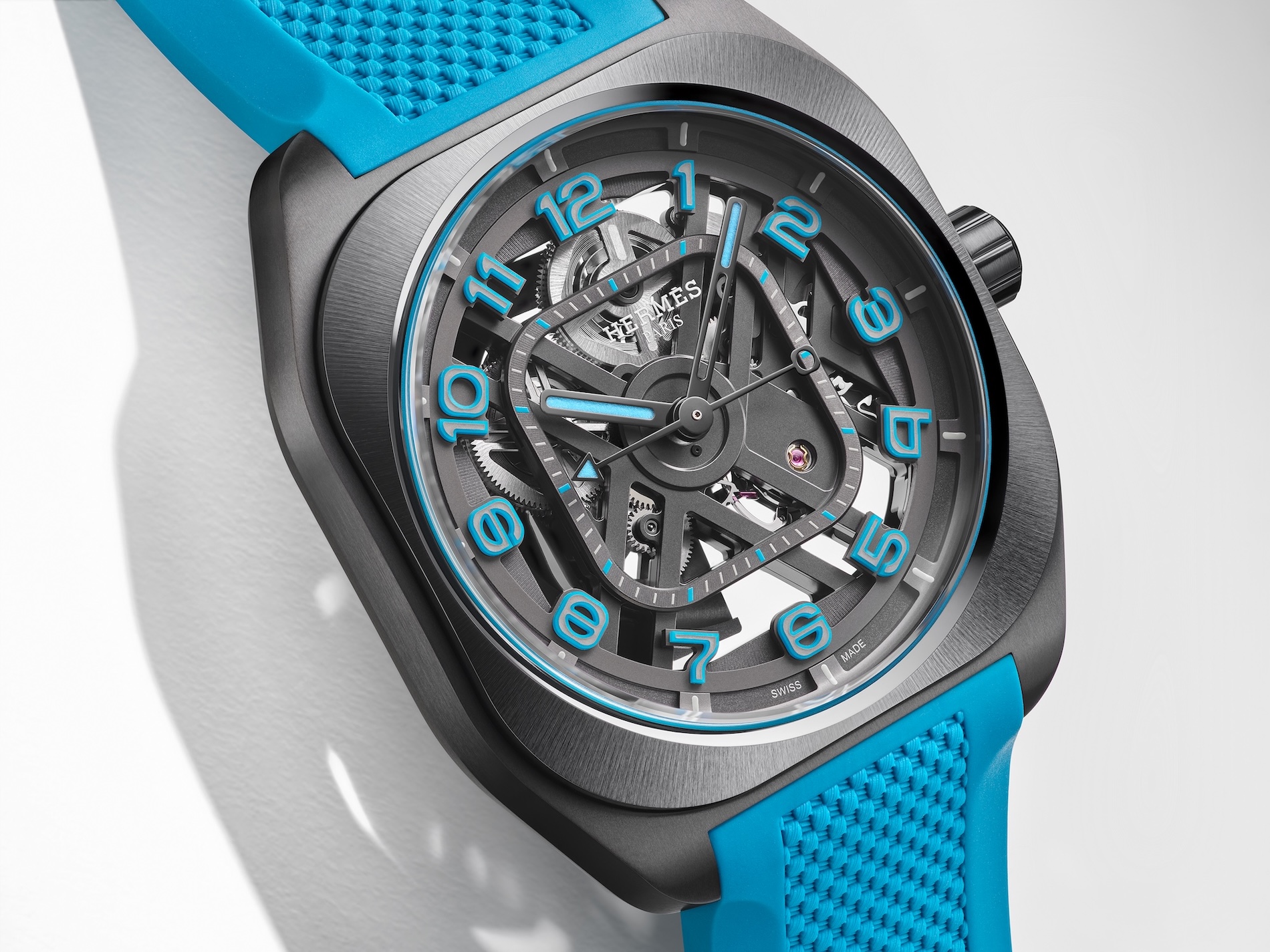
Form and movement in dialogue
Five years after the launch of this sports model, Hermès launched the Hermès H08 Skeleton in 2026. This is neither a traditional skeleton watch nor a simple openwork version of its best-seller. Building on the success of the Hermès H08, the House had an architectural form strong enough for this design language to extend right down to the movement itself.
In classic skeletonisation, the art lies in removing as much material as possible from a movement whilst preserving its rigidity. Here, the approach is different: the new skeletonised H1978 S automatic calibre, manufactured by Hermès, developed in collaboration with Vaucher Manufacture Fleurier and made predominantly from titanium, has been designed as an integral part of the watch’s architecture. Its mainplate and bridges follow the geometry of the case. An X-shaped structure runs through the movement and supports the gear train, whilst the rotor also echoes the watch’s cushion shape. The eye wanders through this architecture, leading it to the very heart of the movement: like a window opening onto the passage of time.
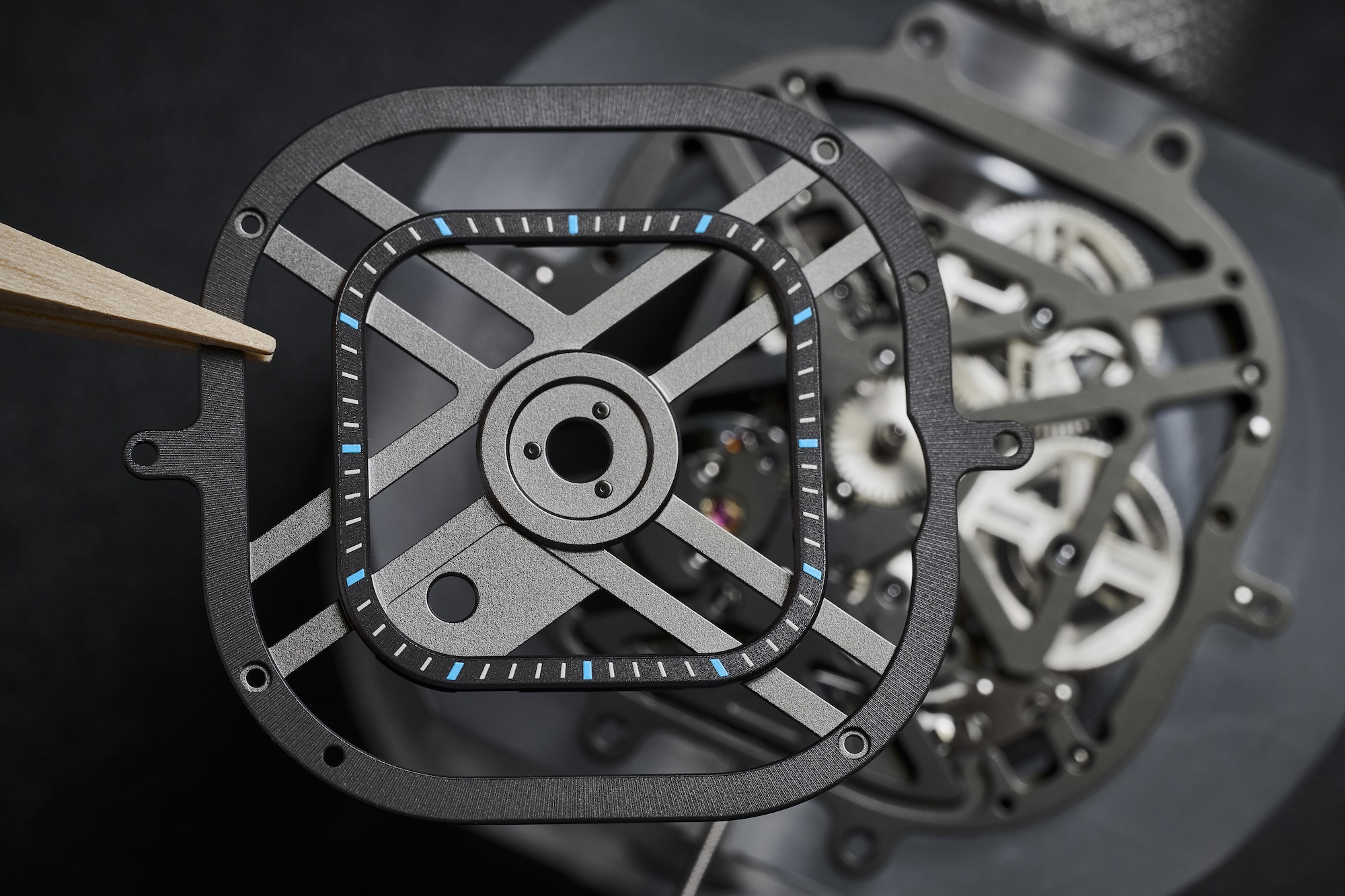
In 2021, the movement was integrated into the design of the Hermès H08. In 2026, the movement becomes the design itself. One could almost speak of ‘designer skeletonisation’ rather than decorative watchmaking skeletonisation: the external form and the mechanical architecture speak the same language. And this is where the Hermès H08 Skeleton breaks new ground: it is not a mechanical revolution but a new conception of the skeleton in which form and function engage in dialogue.
“This new launch is part of a strategic drive to elevate the Hermès H08 range towards more technical models featuring complications, in line with the recent launch of the chronograph. It also enables us to continue developing and establishing the line as a key pillar of our mechanical watch collection, affirming its distinctive identity centred on innovative materials, its versatile nature and its relaxed spirit. Furthermore, this timepiece showcases our watchmaking expertise through the introduction of a new-generation in-house titanium movement, presented here in its skeletonised version,” emphasises Philippe Delhotal.
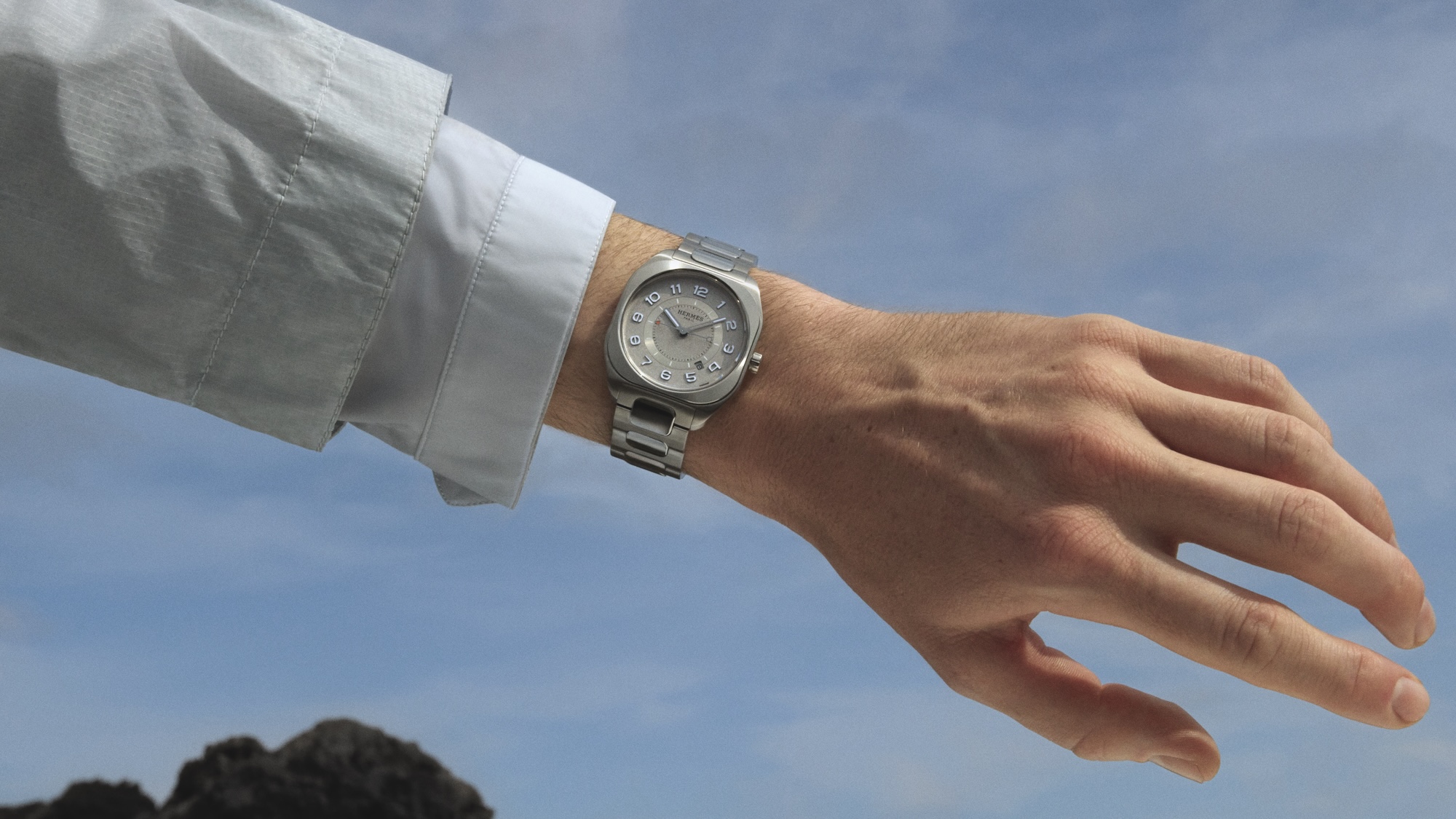
For five years, the Hermès H08 has carved out a prominent place for itself in the world of sports watches, without losing any of its elegance. Over the years, Hermès has given it new looks, new materials and equipped it with new functions. Its highly recognisable case and dial lend themselves to all manner of developments, provided its spirit endures. What will the next chapter be called?