
Slim d’Hermès Pocket Roaaaaar ! When the lion emerges from the woods
Three hundred and fifty-two pieces of wood, around ten different species, fragments sometimes smaller than a speck of dust, and 125 hours of painstaking work: that is what it took to bring to life the lion adorning the cover of the Slim d’Hermès Pocket Roaaaaar! pocket watch. Behind this extraordinary feat of miniature marquetry is Olivier Varenne, a master craftsman who has perfected the art of creating images of astonishing delicacy from a handful of wood veneers. We went to meet him. Isabelle Cerboneschi
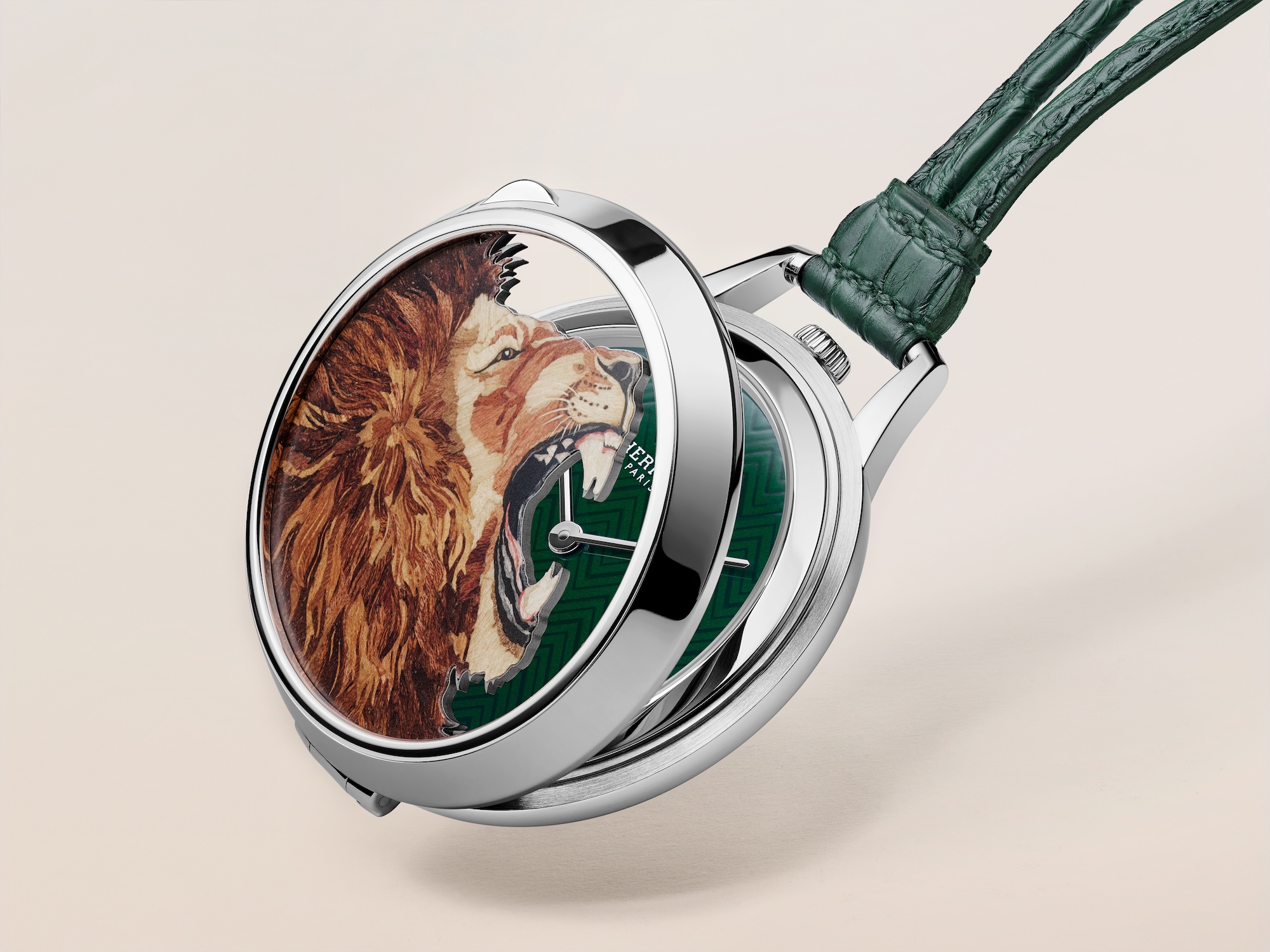
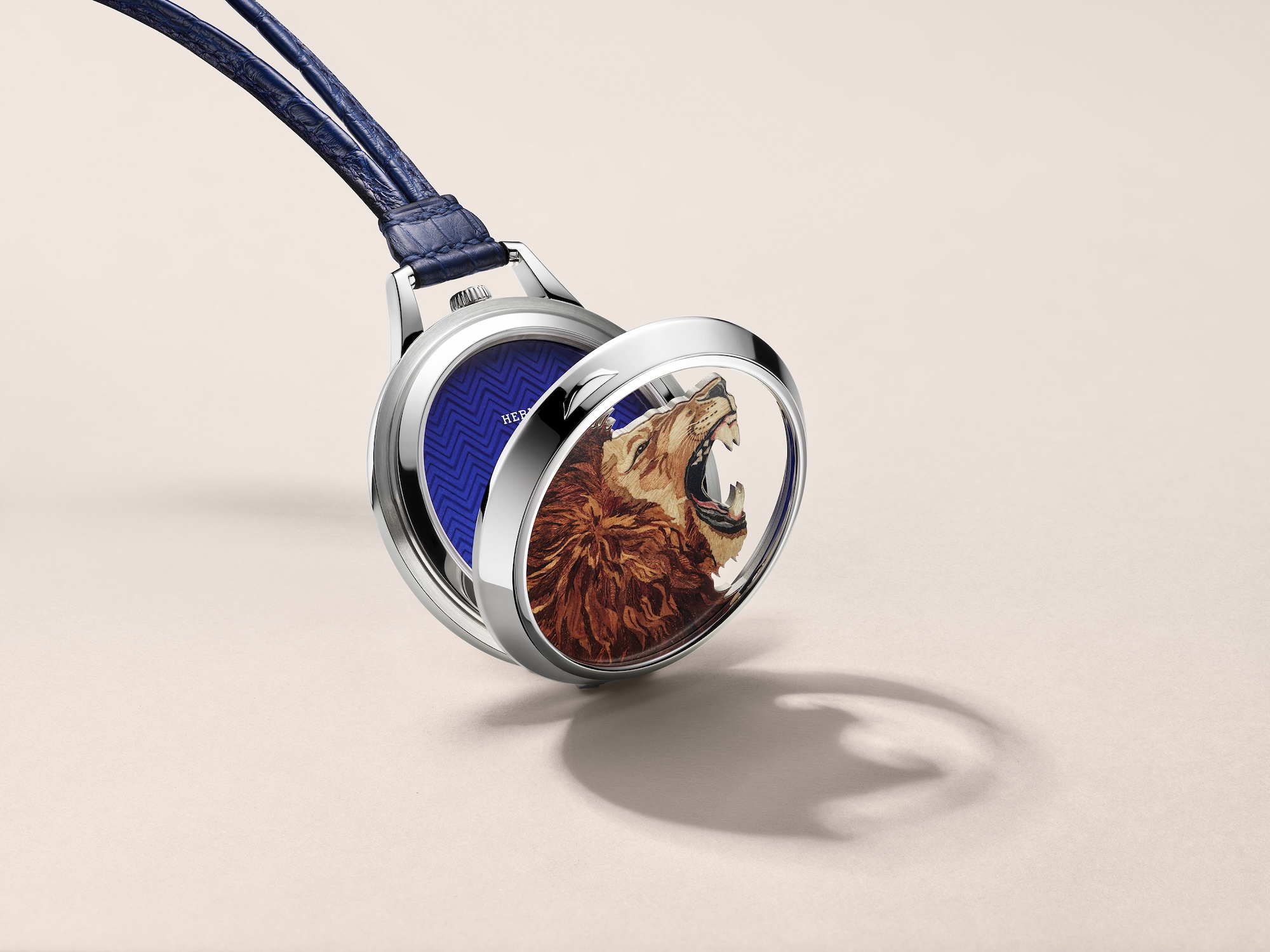
Last April, a roaring lion was displaying its formidable power in one of the Hermès showcases at Watches and Wonders. Visitors had nothing to fear: although the animal looked ready to devour the world, it was firmly confined to the cover of a pocket watch, the Slim d’Hermès Pocket Roaaaaar!
At first glance, I took it for an exquisite example of miniature painting and was about to turn my attention to another timepiece when someone explained that the image was actually made of wood marquetry. Marquetry? Impossible! Surely no one could cut individual strands of a lion’s mane so fine from sheets of wood veneer. Still less that microscopic glint of white light in the animal’s already minuscule pupil. And yet, appearances can be deceptive… The small information panel beside the watch clearly stated that the motif was indeed made of wood marquetry.
At Hermès, 90 per cent of Métiers d’Art dials take their inspiration from the house’s legendary silk scarves, and it is the designs themselves, created by artists, that determine which artistic technique will be used.
“We select around forty designs, mainly from the current year’s collections,” Philippe Delhotal, Creative Director of Hermès Horloger, explained in an earlier interview. “We spread them out on the floor and sort them into themes: animals, abstract, contemporary, classic, equestrian and so on, to achieve a balance. We then choose around twenty, which we approve with Pierre-Alexis Dumas, Hermès’s General Artistic Director. The next step is to decide which type of watch best suits each motif. The design itself guides us. If it is particularly intricate and detailed, it makes sense to use it on a larger timepiece, giving the composition more room to breathe. Finally, we have to find the technique that will do the design justice and reveal its full beauty.”
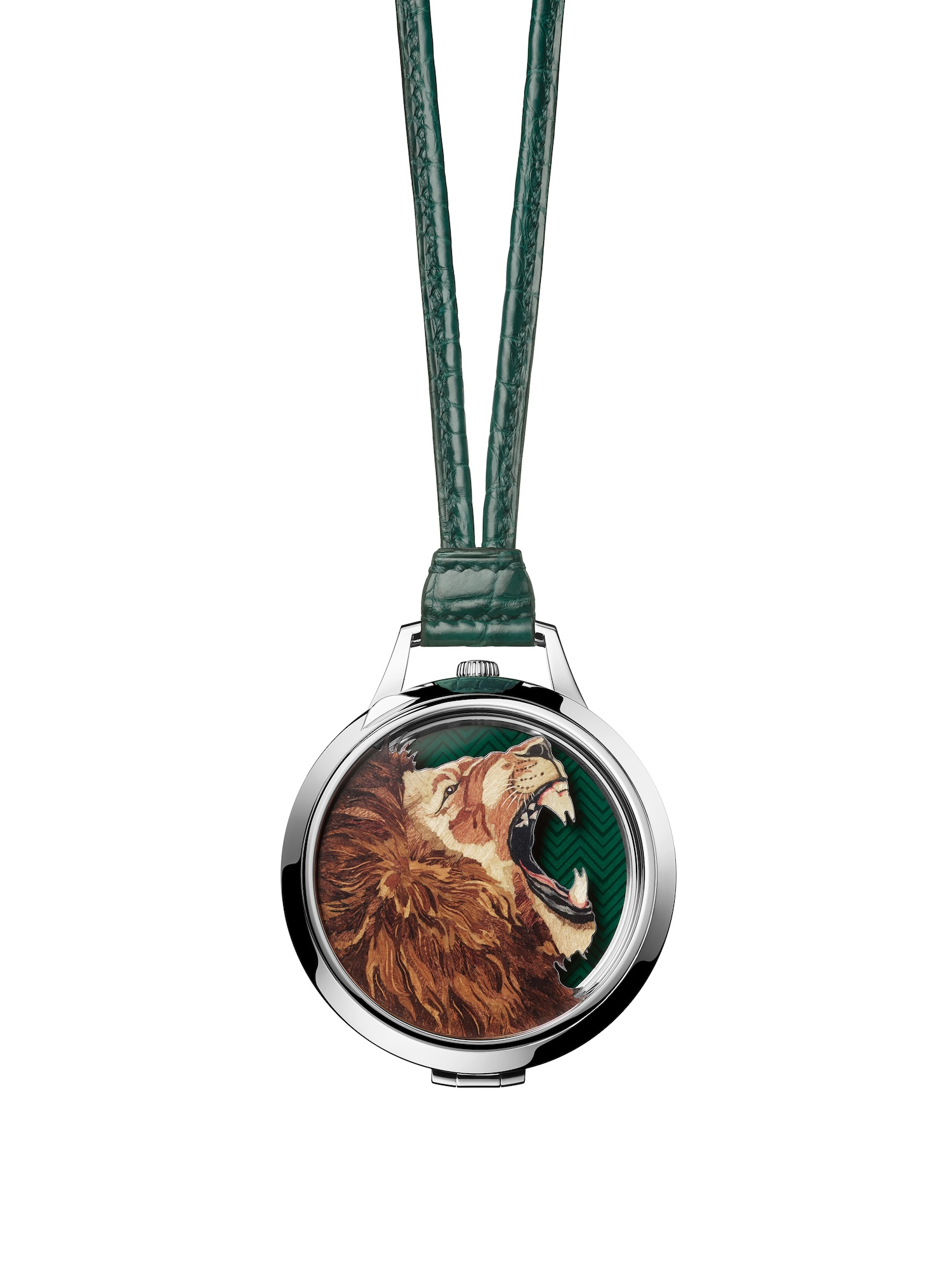
The more I lost myself in contemplating this piece, the greater my desire grew to meet the craftsman behind it. I had to understand, to see it with my own eyes to believe that this lion was indeed a micro wood marquetry piece, handcrafted by an artisan.
Meeting Olivier Varenne is no mean feat. You have to travel to Paris, then allow an hour’s drive to reach a village where time seems to have stood still 300 years ago. Behind tall gates, a château comes into view, surrounded by houses arranged like gemstones on a crown. The gate of one of these opens onto a family home and its adjoining workshop. This is the realm of Olivier Varenne and his sister Virginie, who work together in this family business. It is here, in this quiet village where the clamour of the world seems to have no reach, that the magic happens.
Wood: A Family Affair
Olivier Varenne’s passion for wood began long before his encounter with watchmaking. It took root in his father’s workshop, among the wood shavings and sawdust.
“I come from a family that has worked with wood from father to son for four generations,” he explains. “Before me, the family was mainly involved in furniture restoration and cabinetmaking. My father worked from home. He had his own workshop in the garden. Inside, I had a little workbench with children’s tools, where I would make small wooden objects. We grew up immersed in that world, surrounded by the scent of wood and everything that makes this material so distinctive.” Whenever anyone asked the young Olivier what he wanted to be when he grew up, his answer was invariably the same: he wanted to follow in his father’s footsteps.
After studying at the École Boulle in Paris, he discovered miniature marquetry for watchmaking during a work placement in Switzerland. He immediately fell in love with a world in which the demands of precision reached almost unimaginable levels. “I discovered a form of craftsmanship that was even finer, more precise and more demanding than anything I had learnt at school. And the fact that it was connected to watchmaking made it all the more fascinating,” he recalls.
Unlike engraving or grand feu enamelling, techniques that have been used in watchmaking for centuries, miniature wood marquetry only began appearing on watch dials around twenty years ago. Yet the gestures involved are rooted in much older traditions.
“We don’t have a laser in the workshop. Precision comes from the craftsman’s dexterity, experience and knowledge of his tools. The techniques and glues we use are the same as those employed when marquetry and cabinetmaking first emerged. We make the same gestures as the craftsmen of the Renaissance.”
Translating a Drawing into Wood
When Hermès presented him with the drawing of the lion destined to adorn the cover of a pocket watch, Olivier Varenne was immediately enthusiastic, despite the extraordinary delicacy of certain details — or perhaps precisely because of it.
“I thought the design was magnificent from the outset, and particularly well suited to marquetry. Animals lend themselves beautifully to this technique because different species of wood allow us to recreate the textures of fur, whether short or long. With this lion, we could really make use of the wood grain, particularly in the mane.”
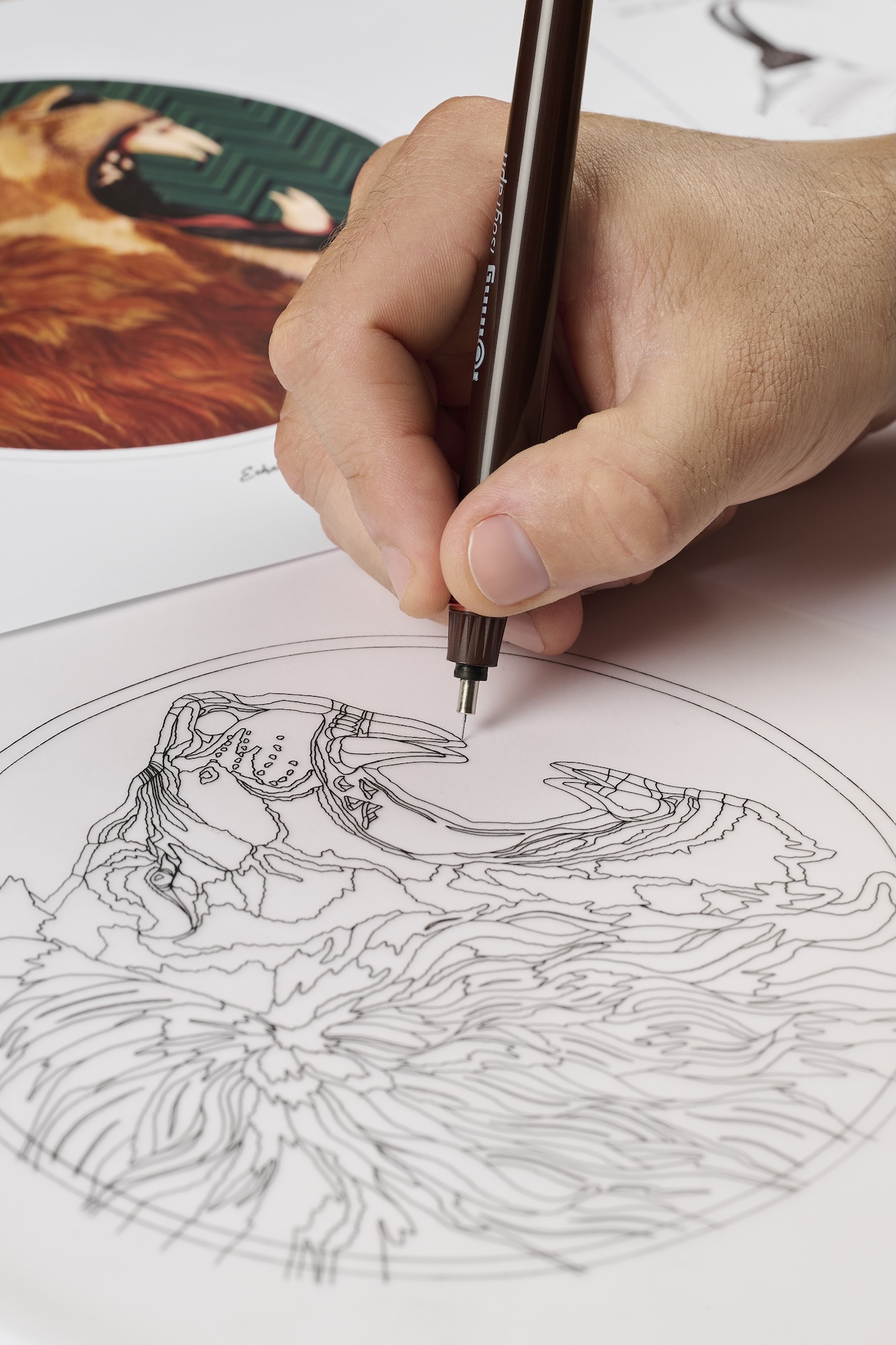
The first challenge was to produce what the craftsman calls a line drawing. Using a fine precision pen, he traces the design, outlining every individual piece that will eventually make up the marquetry. Each line represents a joint between two pieces of wood. Every subtle variation in colour must find its equivalent in a particular species, while every detail must be considered in relation to what can actually be cut.
The drawing is then reduced to its final dimensions, the templates printed, cut out with a scalpel and glued onto the selected wood veneers. For the lion alone, 352 individual templates were prepared.
A Palette Created by Nature
The marquetry craftsman works with an extraordinary palette of veneers: hundreds of wood species from different parts of the world. Each has its own colours, grain, fibres and density.
“I have to take all these characteristics into account when selecting the wood,” Olivier Varenne explains. “When we receive a new project, we begin by considering which species will best reproduce the colours and textures we are looking for. For the lion’s mane, for example, we need wood with a grain that suggests long hair. For the face, we look for textures that evoke short fur.”
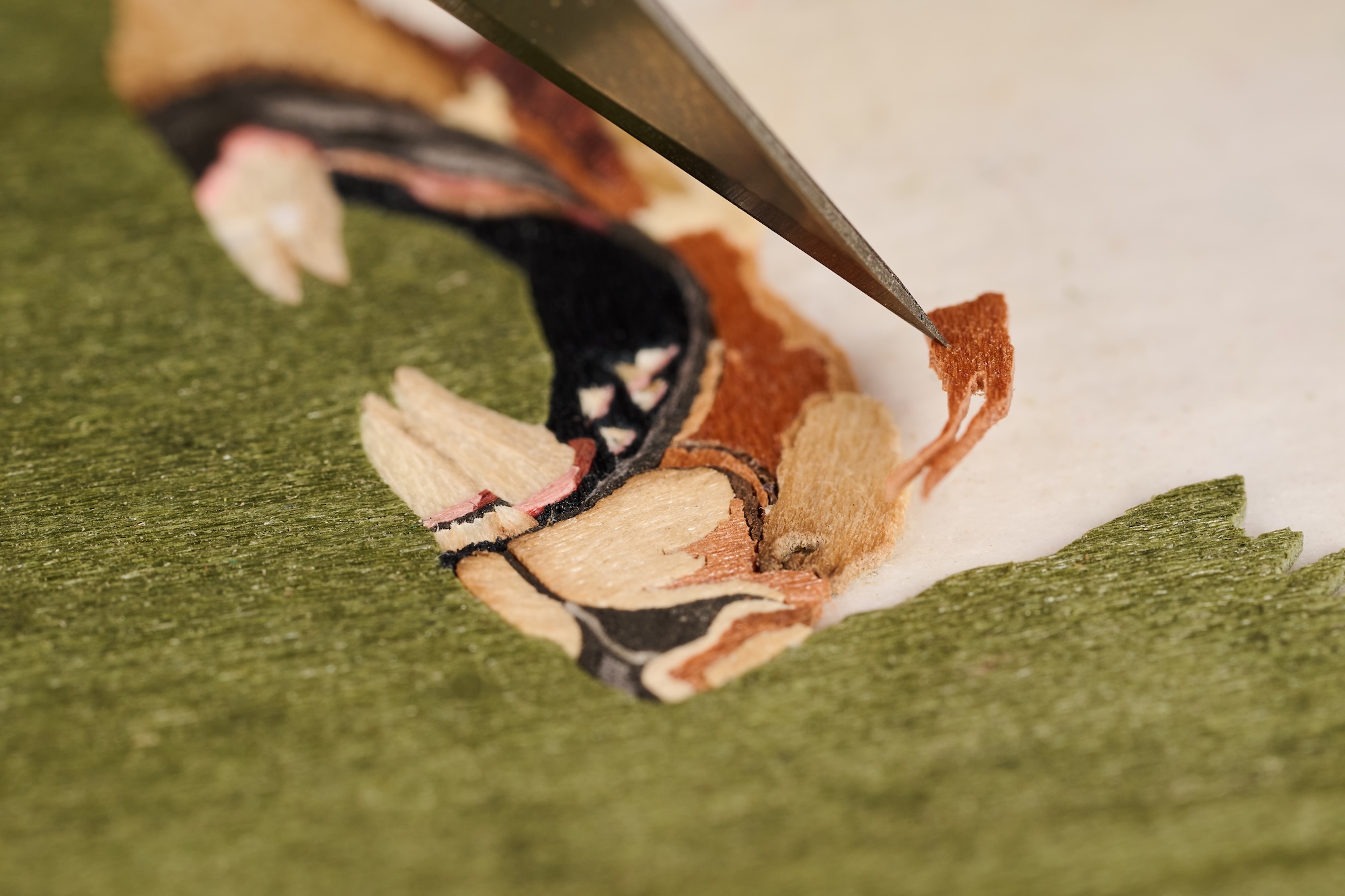
To give the fangs a sense of volume, he selected two woods with subtly different tones: bleached tulipwood, almost white, and sycamore maple, with its slightly ivory hue. The two lower teeth alone are composed of ten separate pieces of wood.
By juxtaposing these shades, he creates the illusion of light, shadow and a third dimension, even though the surface is perfectly flat. Quite extraordinary, when you think about it…
Certain areas have been gently darkened through contact with heat, a traditional technique used to create shading. The pinkish areas inside the lion’s mouth, meanwhile, required the use of dyed wood.
Precision to a Hundredth of a Millimetre
Then comes the cutting, probably one of the most astonishing stages of the entire process.
Each fragment is cut individually using a powered fretsaw. A small motor drives the blade, but its path is controlled entirely by the craftsman’s hand and eye. At this scale, the slightest deviation can jeopardise the whole composition.
“The cutting is absolutely fundamental,” Olivier Varenne explains. “If we are not perfectly precise, the pieces simply won’t fit together properly. If we remove too much material, gaps appear between them. If we don’t remove enough, the pieces press against one another and may break. We work to a precision of one hundredth of a millimetre. An error of just a few hundredths, repeated across several hundred pieces, can create a considerable misalignment. Eventually, the marquetry may become impossible to assemble.”
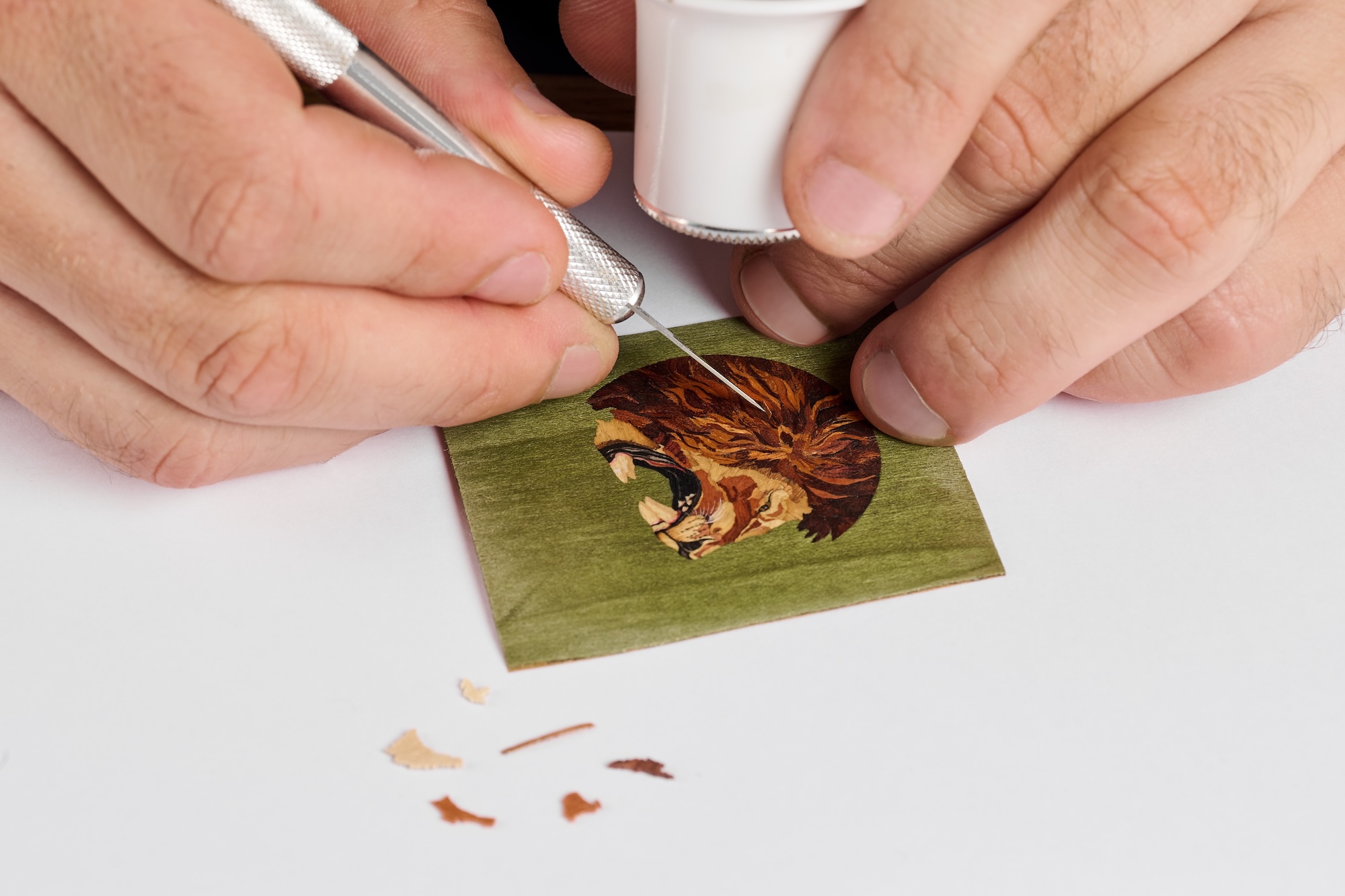
The aim is to achieve such a perfect fit that the joins between the pieces disappear, leaving the viewer with the impression of looking at a painting. Mastering this skill takes years of practice, but also requires a particular physical and mental disposition.
“We use a marquetry technique known as ‘piece by piece’. Every element is sawn individually and then fitted together with the others, rather like a jigsaw puzzle. It is a traditional technique whose main stages have remained essentially unchanged for centuries. The more you saw, the better you understand the tool. The better you know it, the more comfortable you become, and the further you can push the limits of precision. You also need to be relaxed to achieve real fluidity of movement. At first, all your concentration is focused on following the line. With experience, the cutting becomes almost instinctive. The ultimate aim is to become virtually one with the machine.”
Strands of Wood and a Glint in the Eye
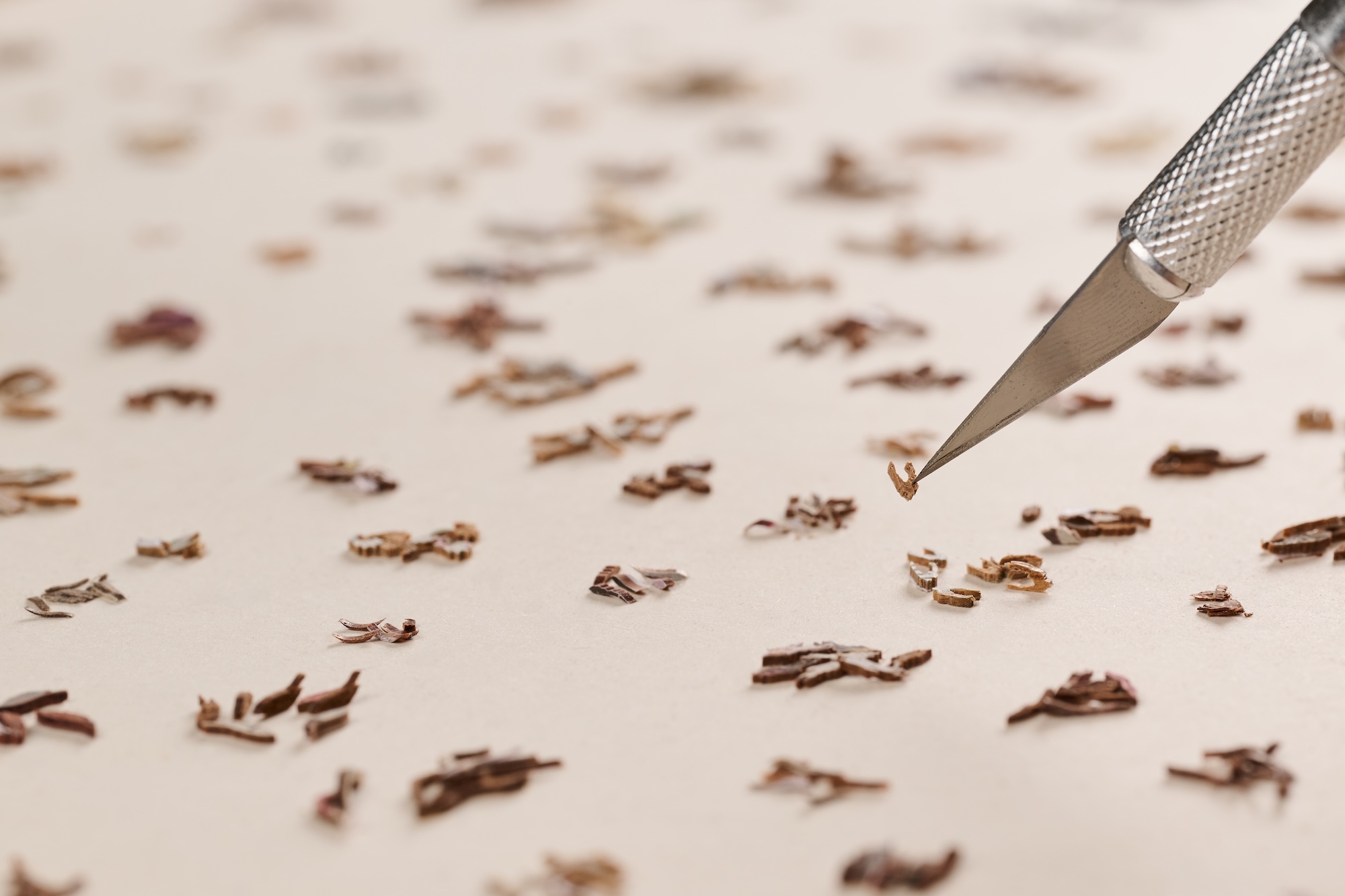
The most spectacular elements of this marquetry are also the least visible. Take the lion’s whiskers, for example: tiny strands that Olivier Varenne describes as “hairs made of wood”, which he painstakingly cut before inlaying them into the larger pieces.
And then there is that tiny white reflection in the lion’s pupil: a minuscule fragment of white wood measuring just a few tenths of a millimetre. “That tiny point of light brings the gaze to life. Without it, the animal’s expression changes completely.”
This almost invisible fragment is one of the 352 pieces that make up the lion adorning the cover of the Slim d’Hermès Pocket Roaaaaar! Every single one has been cut by hand, with precision measured in hundredths of a millimetre, before being assembled so perfectly that the joins disappear.
It took 125 hours of work to transform around ten different species of wood into a roaring lion.
A Jigsaw Puzzle Assembled with a Scalpel
Assembling the marquetry is another formidable test of patience.
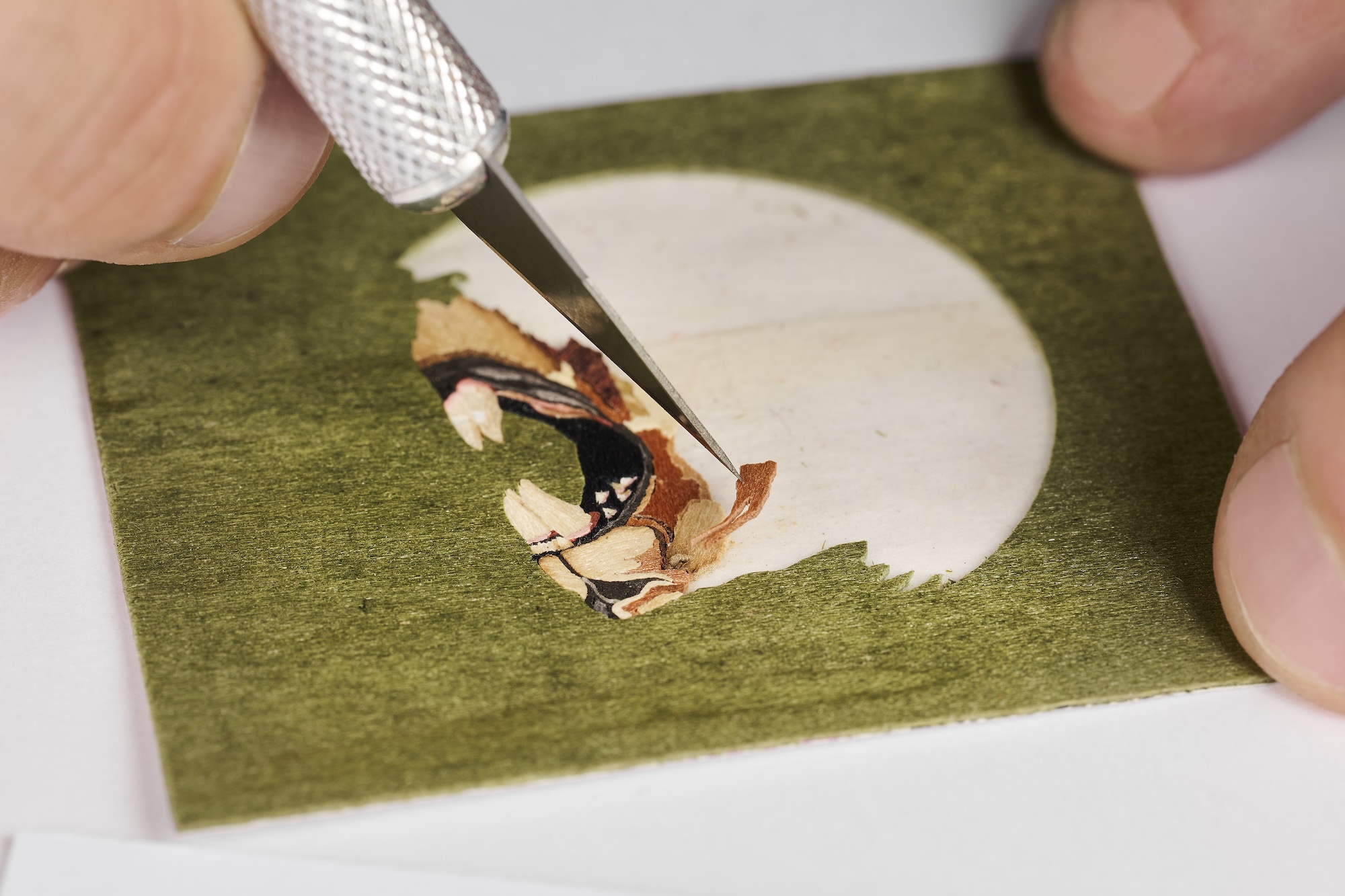
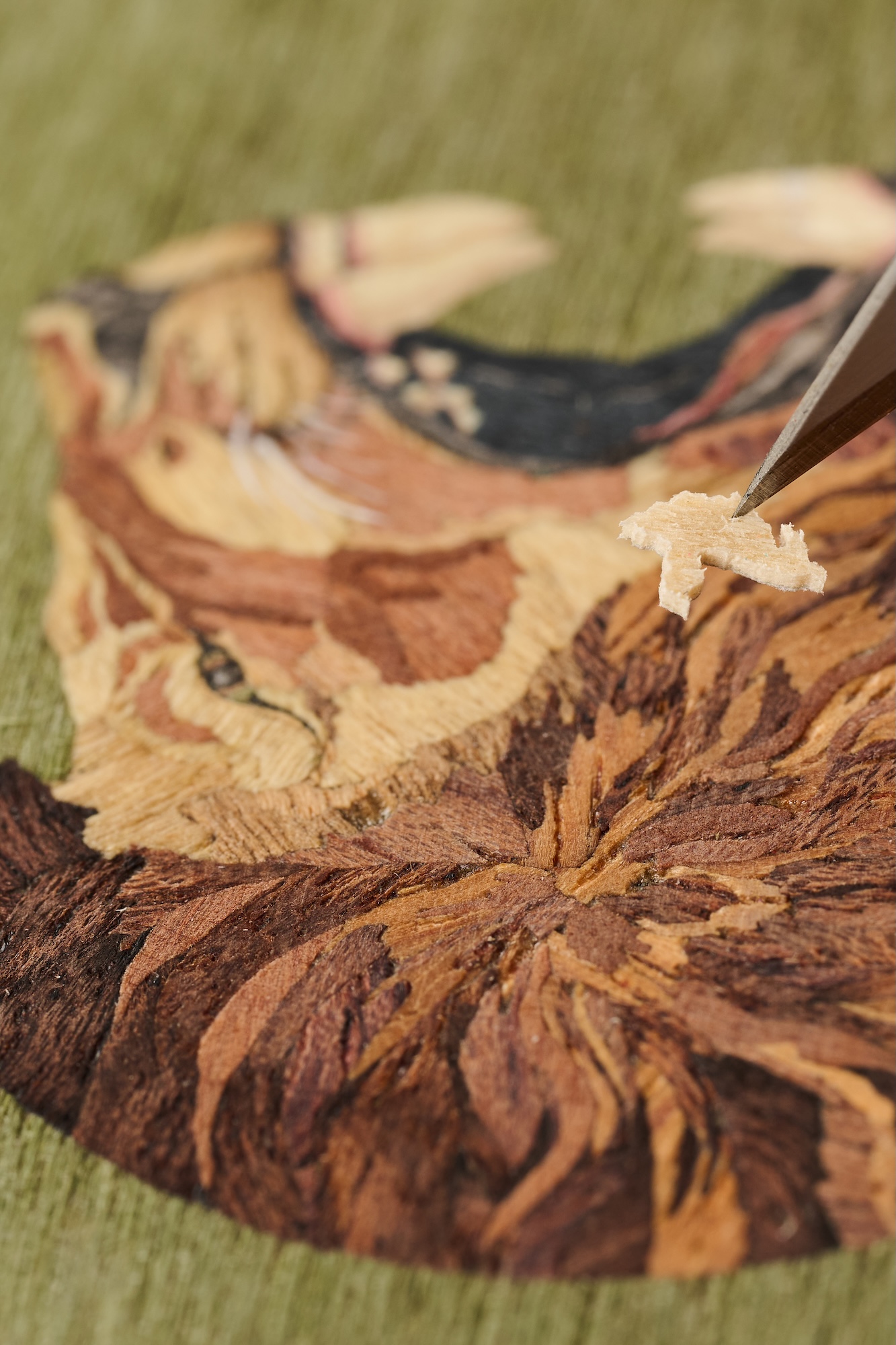
Upstairs, on a wooden board, I discover the 352 pieces that make up the lion. One ill-timed sneeze and hours of painstaking work could be lost. This room is a nightmare for anyone with a tendency towards clumsiness. Olivier Varenne positions the fragments one by one. To pick them up and move them, he uses the tip of a scalpel, gently piercing the surface of the wood without damaging it.
Once all the elements have been assembled, several transfer operations are required to carry out the gluing stages before the marquetry is finally secured to the brass base forming the cover of the pocket watch. The gluing process combines traditional methods with techniques adapted to the specific demands of watchmaking. The craftsman uses, among other things, rabbit-bone glue, similar to the adhesives employed in traditional cabinetmaking, followed by a two-part adhesive to permanently bond the marquetry to its support.
A UV-resistant satin varnish is then applied to protect the wood while preserving its texture and the richness of its natural tones.
Watchmaking: A Guardian of Traditional Skills
The very existence of this craft at such an extraordinary level of miniaturisation is closely linked to the demands of the watchmaking industry.
In other fields, marquetry craftsmen often have to divide their time between restoration, interior fittings, furniture-making and artistic creation. Commissions from watchmaking houses allow Olivier Varenne and his fellow craftsmen to devote themselves entirely to researching and perfecting this exceptionally demanding discipline.
“Marquetry would have much greater difficulty surviving without watchmaking,” Olivier Varenne points out. “Watchmaking houses, particularly Hermès, help sustain workshops, preserve a great many traditional skills and maintain exceptionally high standards. Thanks to watchmaking, we can devote ourselves entirely to our speciality. Above all, these houses constantly encourage us to go further. Their demands compel us to refine our techniques, find new solutions and achieve levels of precision that we might never have developed otherwise.”
But this relationship extends well beyond the commissioning and making of an object. By inviting craftsmen to present their work to collectors, Hermès gives them the opportunity to meet the very people who acquire their creations. For someone who spends his days in a workshop, concentrating on fragments of wood measuring only a few tenths of a millimetre, such encounters have a special significance.
“What is extraordinary is seeing people arrive wearing watches we have worked on,” the craftsman confides. “In the workshop, we don’t always get to see the pieces once they have been finished and assembled. Sometimes we only know them through photographs. Thanks to these events, we can discover our creations being worn on their owners’ wrists. That is quite a rare experience for a craftsman.”
When a piece finally leaves his workshop, Olivier Varenne experiences a mixture of pride and nostalgia. He knows that the object on which he has spent hundreds of hours will become part of someone’s collection. “There is always a little pang of nostalgia,” he admits, “but we are happy to see a piece completed, to know that its new owner will wear it and, we hope, derive a great deal of pleasure from it.”